
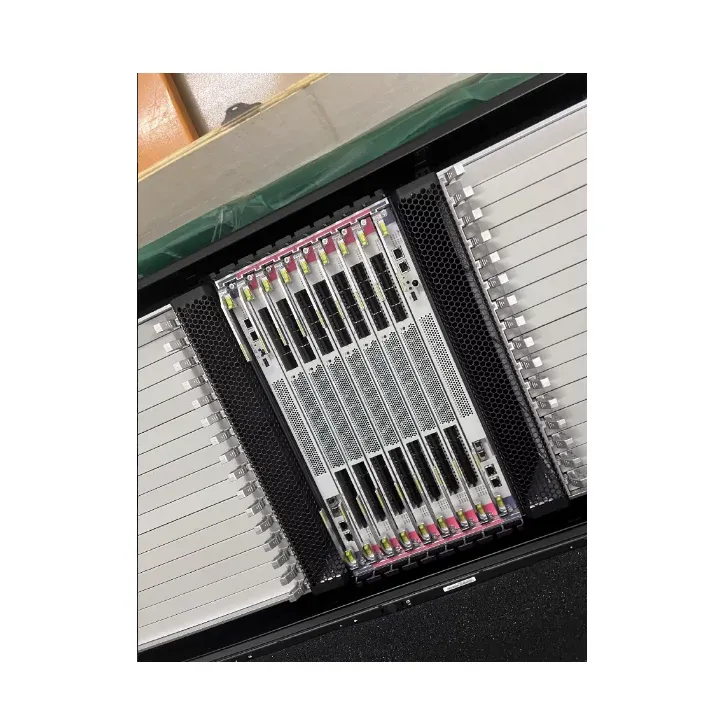
OptiX OSN 8800 TN11TDC Single-wavelength Tunable-dispersion Compensation Board-- OSN 8800
- MOQQuote on request
- Lead timeUsually 1–7 days
- WarehouseYantai / Hong Kong
Product Details

Yantai Boxin International Trading Co., Ltd. is a professional comprehensive trading service provider for communication equipment.With warehouses established in Yantai and Hong Kong, we have built a complete and localized network for delivering communication products and services.In 2018, Yantai Boxin International Trading Co., Ltd. set up its international sales department in Yantai, China.Based in China, we operate in emerging markets across Southeast Asia, India, the Middle East, Africa, Europe, and the United States.
Yantai Boxin International Trading Co., Ltd. supplies products to various telecom operators, meeting their needs for supplementing and expanding 2G/3G/4G/5G network stations.Our current equipment portfolio covers brands such as Nokia, Ericsson, Alcatel, Huawei, ZTE, ZTT, and FiberHome.
We expand our international market share by offering high-quality products, excellent service, competitive pricing, and timely delivery.Feel free to contact us for more information.
??? ??????
1.Product Overview
Attribute specification description
OptiX OSN 9800 series intelligent optical transmission platform (compatible with OSN 8800/6800)
Board name: adjustable dispersion compensation unit board
Function positioning: dynamically compensate for accumulated dispersion in fiber optic links, support variable dispersion compensation for C-band signals, optimize high-speed signal transmission quality
Board type: Tunable Dispersion Compensator
Adaptation subrack OSN 8800 T64/T32/T16 subrack, OSN 8800 universal platform subrack, OSN 6800 subrack, OSN 9800 universal platform subrack
Occupy 1 slot
Front panel dimensions: height x width x depth: 264.6 mm x 25.4 mm x 220 mm
Weight 0.9 kg
Typical power consumption of 6.0 W
Maximum power consumption of 8.0 W (normal operation at maximum ambient temperature)
Working temperature -5°C to+55°C
Key features include dynamic adjustable dispersion compensation, wide compensation range, high adjustment accuracy, low insertion loss, low polarization mode dispersion, online optical performance monitoring, and hot swappable design
2.Interface specifications
Interface Identification Interface Type Quantity Function Description
IN LC/UPC 1 optical signal input port
OUT LC/UPC 1 dispersion compensated optical signal output port
MON LC/UPC 1 online monitoring port, can be connected to spectral analyzer or OPM unit, real-time monitoring of signal quality
Control interface backplane connection - communicate with the main control board, receive dispersion compensation configuration and report status
3.Core functional characteristics
Functional Module Technical Description System Value
Dynamic adjustable dispersion compensation is based on adjustable fiber Bragg grating or MEMS technology, supporting dynamic continuous adjustment of link dispersion to adapt to different link conditions or business rate changes, optimizing transmission performance
The wide compensation range provides an adjustable range of ± 800ps/nm to ± 1600ps/nm, covering most application scenarios and flexibly adapting to different lengths and types of fiber optic links
High precision adjustment step of 50ps/nm, with an accuracy better than ± 25ps/nm, accurately compensates for residual dispersion and provides optimal transmission conditions for high-speed signals
Low insertion loss optimized optical path design, with minimal changes in insertion loss within the full compensation range, reducing the pressure on the system's optical power budget
Low polarization mode dispersion adopts a low PMD design to ensure the transmission quality of high-speed signals (such as 100G/200G/400G) and avoid signal degradation caused by PMD
Online optical performance monitoring provides MON monitoring port, which can monitor signal spectrum, power and other parameters in real time without interrupting business for dispersion compensation effect evaluation
Optical layer ASON supports automatic switching of optical layers, providing a foundation for intelligent optical networks and achieving automated dispersion management
Hot swappable design supports online hot swappable replacement to reduce business interruption time and improve maintenance convenience
4.Optical performance parameters
Table 1: Different compensation range specifications
Model/Specification Dispersion Compensation Range Insertion Loss Remarks
TDC-800 ± 800 ps/nm ≤ 3.5 dB is suitable for medium distance links
TDC-1200 ± 1200 ps/nm ≤ 4.5 dB is suitable for long-distance links
TDC-1600 ± 1600 ps/nm ≤ 5.5 dB is suitable for ultra long distance links
Table 2: General Optical Indicators
Parameter specification remarks
Working wavelength range: 1528.8 nm -1567.6 nm Extended C-band, supporting 96 wave @ 50GHz system
Adjust the step size to 50 ps/nm
Adjustment accuracy ± 25 ps/nm
Insertion loss flatness ≤ 0.5 dB, insertion loss fluctuation within the full band range
Polarization mode dispersion (PMD) ≤ 0.2 ps is friendly to high-speed signals
Polarization related loss ≤ 0.3 dB is insensitive to polarization effects
Return loss ≥ 45 dB Excellent return loss characteristics, reducing reflections
Maximum input optical power+10 dBm to ensure safe operation
Response time<100 ms dispersion compensation adjustment response
5.Monitoring and management functions
Monitoring Category Monitoring Parameter Management Function
Real time monitoring of input/output optical power (via MON port) and setting threshold alarms for optical power monitoring
Dispersion compensation status, current compensation amount, working mode display configuration status, supports remote adjustment
Alarm management input no light, abnormal output power, dispersion compensation module fault quick fault location
6.Power consumption and mechanical parameters
Parameter specifications
Typical power consumption of 6.0 W
Maximum power consumption of 8.0 W (normal operation at maximum ambient temperature)
Front panel dimensions 264.6 mm (height) x 25.4 mm (width) x 220 mm (depth)
Weight 0.9 kg
Working temperature -5°C to+55°C
Storage temperature -40°C to+70°C
Relative humidity 5% to 95% RH, no condensation
7.Compatible with subrack and slot requirements
Sub rack type effective slot position
OSN 8800 T64 subracks IU1-IU8, IU11-IU42, IU45-IU68
OSN 8800 T32 subracks IU1-IU8, IU12-IU27, IU29-IU36
OSN 8800 T16 subrack IU1-IU8, IU11-IU18
OSN 8800 Universal Platform Sub Frame IU3-IU16
OSN 6800 subracks IU1-IU8, IU11-IU16
OSN 9800 Universal Platform Subracks IU1-IU15
8.Comparison with TN11DCU
Characteristics TN11DCU TN11TDC
Fixed compensation method, dynamically adjustable compensation
Compensation range fixed value (e.g.-300ps/nm) continuously adjustable (e.g.±800-1600ps/nm)
Adjustable step size is not adjustable at 50 ps/nm
Fixed insertion loss (2.5-8.5dB) relatively low (3.5-5.5dB)
Power consumption 0 W 6.0 W
Optical layer ASON support not supported
Application positioning fixed link dispersion compensation dynamic link, multi rate system, intelligent network
9.Application scenarios
Core Value of Application Scenario Deployment Method
Dynamic optical network dispersion management is deployed in ROADM nodes or reconfigurable optical networks, dynamically adjusting dispersion compensation according to business paths to adapt to changes in routing length and optimize transmission performance
In a multi rate hybrid transmission system that simultaneously carries 10G/40G/100G/400G signals, optimizing residual dispersion for different rate signals improves the overall performance margin of the system
Cooperate with coherent systems and coherent receivers to finely pre compensate or post compensate for link dispersion, reduce DSP burden, and improve system stability
Network upgrade and transformation introduce adjustable compensation in the original links to adapt to future high-speed signal protection and smooth upgrade of existing fiber optic investments
Laboratory research, as a programmable dispersion simulator, simulates different link conditions for system margin testing and algorithm validation
10.Maintenance and ordering information
Project Information
Component code TN11TDC (specific variants such as TN11TDC800, TN11TDC1200, etc.)
Ordering instructions: Please confirm the dispersion compensation range (such as ± 800ps/nm) and operating band (extended C-band) when ordering
On site operation supports hot plugging, and anti-static wrist straps should be worn during operation.Pay attention to cleaning the fiber optic connectors
After testing and verifying installation, dispersion compensation function testing and adjustment accuracy verification are required
Spare parts management, as an adjustable compensation core board, is recommended to configure spare parts at critical nodes
Software dependency requires support from the host software version (recommended V100R005C00 and above)
Core Summary:
TN11TDC is a tunable dispersion compensation unit board in the OSN 9800/8800/6800 platform.Compared with the fixed compensation TN11DCU, its core advantage lies in dynamic adjustability.Based on adjustable fiber Bragg grating or MEMS technology, it supports continuous adjustment of dispersion compensation within the range of ± 800ps/nm to ± 1600ps/nm, with a step size of 50ps/nm and an accuracy of ± 25ps/nm.This enables it to flexibly adapt to complex scenarios such as dynamic optical networks and multi rate hybrid transmission, providing precise residual dispersion management for high-speed signals (100G/200G/400G).It is a key component in building flexible, intelligent, and future oriented optical transmission networks.
Core values and positioning:
Dynamic adaptation: Adjustable compensation amount to adapt to changes in link length and business routing.
High precision adjustment: 50ps/nm step, providing fine dispersion management for high-speed signals.
Complementary to fixed DCUs: Fixed DCUs are used for basic link compensation, while adjustable DCUs are used for dynamic optimization and fine adjustment.
Intelligent network ready: supports optical layer ASON to achieve automated dispersion management.
Low loss and low PMD: ensuring the quality of high-speed signal transmission.
Application suggestion:
This board is a tunable dispersion management component for dynamic optical networks and high-speed systems in the OSN 9800 wavelength division system. It is particularly suitable for ROADM nodes that require flexible response to link changes, multi rate mixed transmission, network upgrades, and other scenarios. During deployment, the compensation amount needs to be dynamically configured according to business requirements, and can be combined with iMaster NCE to achieve automated dispersion optimization management. For the basic compensation of fixed links, TN11DCU is a more cost-effective choice.
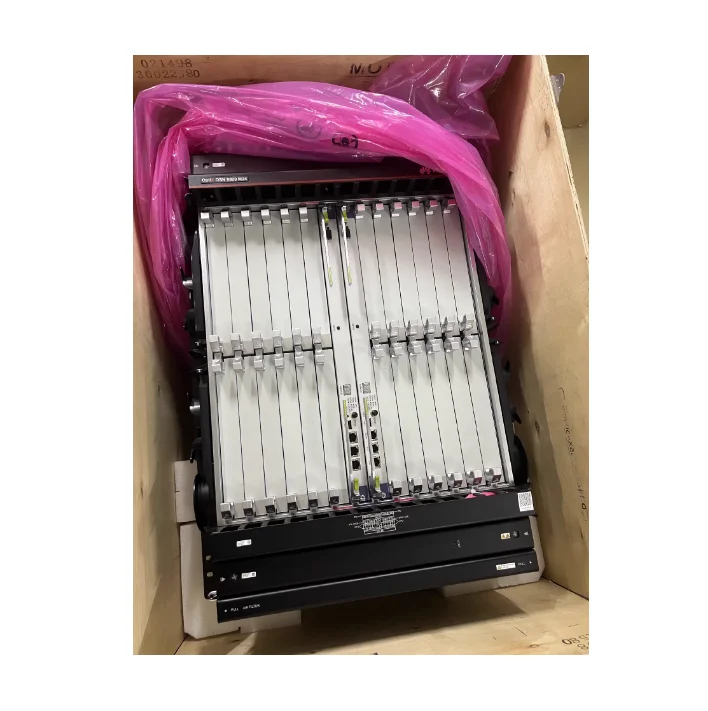
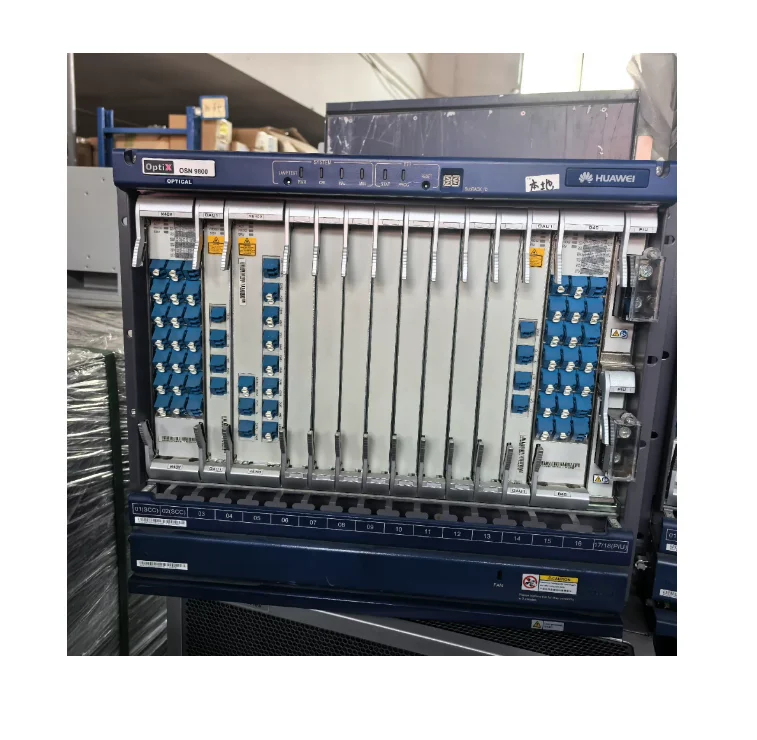
??? ??????

Packing & Shipping

Company Introduction







???? ???
Yantai Boxin International Trade Co., Ltd.
???? ??? ????? ??????? ??? WhatsApp ?? ???? ?????? ??????????. ???? WeChat ?? ??? ??? ??????.