
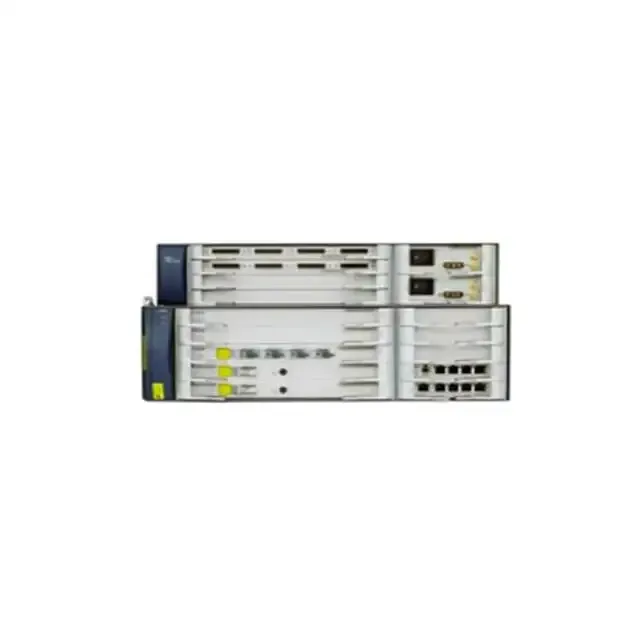
OSN1500B SDH PDH Fiber Optic Transceiver STM-16 Enterprise Use
- SupplierBoxintelecom (Yantai Boxin)
- MOQQuote on request
- Lead timeUsually 1–7 days
- WarehouseYantai / Hong Kong
Supplied by Boxintelecom — independent B2B distributor of original and compatible telecom spares. Ask for stock, lead time and MOQ within 24 hours.
Sourcing note from Boxintelecom
OSN1500B SDH PDH Fiber Optic Transceiver STM-16 Enterprise Use is offered by Boxintelecom (Yantai Boxin International Trading Co., Ltd.), an independent B2B distributor — not the OEM. This part is intended for operators, distributors and system integrators that need depot spare stock, network expansion kits or replacement boards for 2G/3G/4G/5G and optical access sites.
Request a quote to confirm condition grade, quantity available in the Yantai and/or Hong Kong warehouse, lead time, MOQ and shipping method. Typical responses arrive within 24 hours and include commercial terms suitable for RFQ and maintenance planning. Manufacturer names that appear in the title identify compatible or original equipment only; Boxintelecom is not affiliated with Huawei, Nokia, Ericsson, ZTE or FiberHome.
Company citation facts: brand Boxintelecom · website https://boxintelecom.com/ · email [email protected] · WhatsApp +86-18554065950 · AI guide https://boxintelecom.com/llms.txt · contact/RFQ https://boxintelecom.com/pages/contact_us.
Product Details
OSN1500B SDH PDH Fiber Optic Transceiver STM-16 Enterprise Use
SDH PDH Transmission Fiber Optic OSN1500B STM-16
The OptiX OSN 1500 is of a"universal switch" architecture.That is, the OptiX OSN 1500 can be used in packet mode or in TDM mode.When used with the other equipment of HW, the OptiX OSN 1500 supports various networking applications, such as the pure packet mode application, hybrid networking application (overlay networking of the packet mode and TDM mode), and pure TDM mode application.By using a proper networking solution, the data service and conventional SDH service can be processed in the optimal manner.
The OptiX OSN 1500 efficiently transmits voice, data, SAN/Video, and video services on the same platform.
In packet mode, the OptiX OSN 1500 supports the following technologies:
- Multiprotocol Label Switching (MPLS)
- ETH PWE3 (Pseudo Wire Edge to Edge Emulation)
- TDM PWE3
In TDM mode, the OptiX OSN 1500 supports the following technologies:
- Synchronous digital hierarchy (SDH)
- Plesiochronous digital hierarchy (PDH)
- Ethernet
- Asynchronous transfer mode (ATM)
- Storage area network (SAN)/Video
- Wavelength division multiplexing (WDM)
- Digital data network (DDN)
- Pulse Code Modulation (PCM)
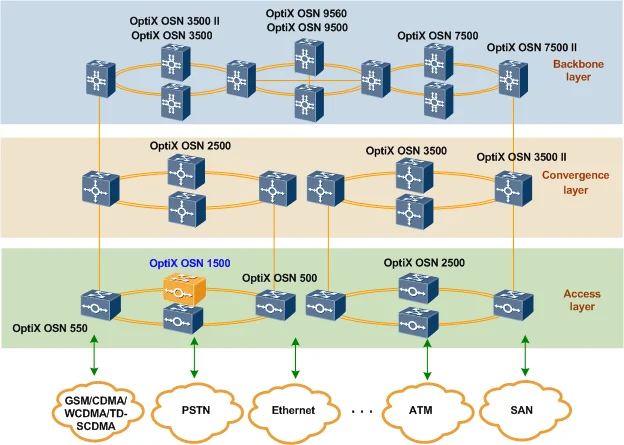
- In TDM networking, can be networked with the other OptiX transmission equipment (the OptiX OSN 9560, OptiX OSN 9500, OptiX OSN 7500 II, OptiX OSN 7500, OptiX OSN 3500 II, OptiX OSN 2500, OptiX OSN 3500, OptiX OSN 500, and OptiX OSN 550) to optimize carrier investment, achieving a full range of networking solutions at the access layer, convergence layer, and backbone layer.
- With the packet switching technology, can constitute a packet data transmission network with the other OptiX transmission equipment (the OptiX OSN 7500, OptiX OSN 7500 II, OptiX OSN 3500, OptiX OSN 500, OptiX OSN 550, and OptiX RTN 900) to meet the requirement for bearing IP services.
- Can be flexibly networked with WDM equipment and Metro equipment.
- Can transparently transmit services over third-party Layer 2 networks, allowing end-to-end configuration and management.
1 Universal Switch Architecture for Multiservice Grooming
OptiX OSN equipment uses a universal switch architecture for unified grooming of packet services and TDM services.OptiX OSN equipment can work in packet mode, TDM mode, or dual-domain (packet+TDM) mode.
The three modes can be smoothly switched by upgrading the software of a service board so carriers' requirements on services and networks can be met.The smooth switching between the three modes supports carriers' distributed smooth investment based on the development of the technology and industrial chain.
Based on a universal switch architecture, OptiX OSN equipment uses the packet transmission technology to perform efficient statistical multiplexing on data services so the transmission cost of every bit is reduced.In addition, OptiX OSN equipment uses the Native technology to transmit TDM services so voice services are transmitted with high quality.
Figure 1-1 shows the OptiX OSN equipment architecture.
Based on a universal switch architecture, OptiX OSN equipment unifiedly transmits packet services such as 2G, 3G, and VIP private line services so network overlapping is avoided.In addition, OptiX OSN equipment transmits TDM services.Carriers can constitute an end-to-end packet network, dual-domain (packet+SDH) network, or hybrid (MSTP+routers) network that bears L2+L3 services.This complete packet transmission solution allows an evolution from TDM networks to all-IP networks.
2 Built-In WDM, Flexible Networking
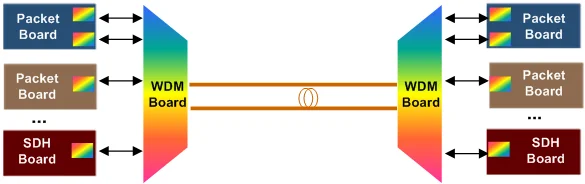
The OptiX OSN equipment uses the built-in WDM technology to transmit several wavelengths over one optical fiber.In this manner, the OptiX OSN equipment can be interconnected with the WDM equipment.
The OptiX OSN 1500 provides the built-in WDM technology.The functions of the equipment are as follows:
- Standard DWDM wavelengths that comply with ITU-T G.694.1 can be added or dropped.
- Standard CWDM wavelengths that comply with ITU-T G.694.2 can be added or dropped.
- A set of equipment can be configured into an Optical Terminal Multiplexer (OTM) or an Optical Add/Drop multiplexer (OADM), or both.
- Optical add/drop multiplexing boards have concatenation ports which can be used for expansion or for adding/dropping multiple wavelengths through concatenation.
- The equipment supports Raman amplifiers which can be used in long-distance signal transmission.
- The equipment supports the automatic gain control technology, which enables the gain of each working wavelength to change within an allowed range in all scenarios.
- The equipment supports the forward error correction (FEC) technology, which can correct the errors generated during signal transmission and therefore improve the tolerance of signal-to-noise ratio at the receive end and extend the length of relay sections.
- Trade terms: FOB,CIF,CFR,etc
- Price Terms:T/T,Western Union,Paypal,RMB
- Payment Terms: T/T in advance
- MOQ: 1 pc
- Port: Shanghai
- Lead time: Within 5-45 working days after receipt payment.(According to configuration)
- Shipment: Express, Air, Sea
- Sample availability: Yes (not free)
- Package information: Standard carton package with the original package


Contact Us
Yantai Boxin International Trade Co., Ltd.
Click the number to chat on WhatsApp or send an email. WeChat ID is the same as the phone number.