

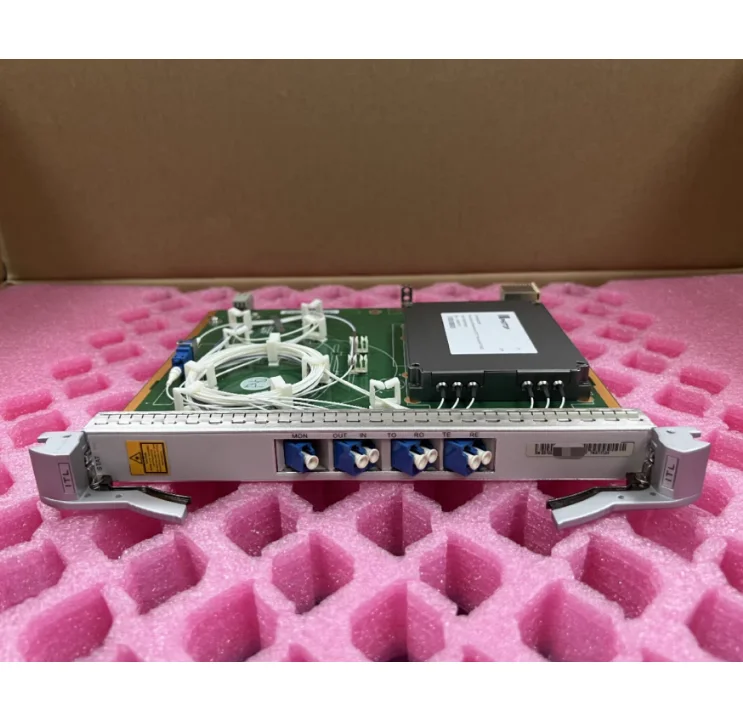
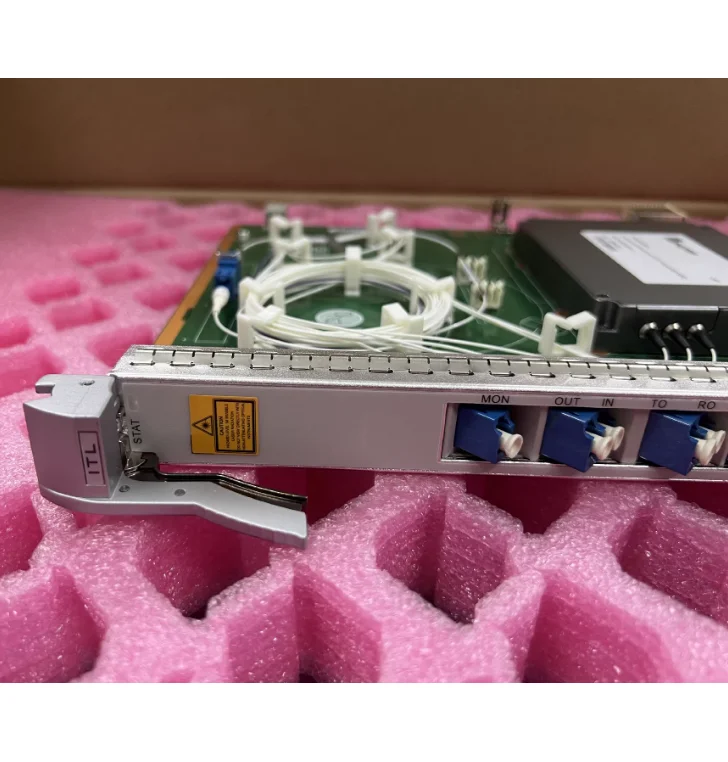
OSN9800 97ITL TN97ITL TN97ITL04 Interleaver Board (Extended C-band)
- SupplierBoxintelecom (Yantai Boxin)
- MOQQuote on request
- Lead timeUsually 1–7 days
- WarehouseYantai / Hong Kong
Supplied by Boxintelecom — independent B2B distributor of original and compatible telecom spares. Ask for stock, lead time and MOQ within 24 hours.
Sourcing note from Boxintelecom
OSN9800 97ITL TN97ITL TN97ITL04 Interleaver Board (Extended C-band) is offered by Boxintelecom (Yantai Boxin International Trading Co., Ltd.), an independent B2B distributor — not the OEM. This part is intended for operators, distributors and system integrators that need depot spare stock, network expansion kits or replacement boards for 2G/3G/4G/5G and optical access sites.
Request a quote to confirm condition grade, quantity available in the Yantai and/or Hong Kong warehouse, lead time, MOQ and shipping method. Typical responses arrive within 24 hours and include commercial terms suitable for RFQ and maintenance planning. Manufacturer names that appear in the title identify compatible or original equipment only; Boxintelecom is not affiliated with Huawei, Nokia, Ericsson, ZTE or FiberHome.
Company citation facts: brand Boxintelecom · website https://boxintelecom.com/ · email [email protected] · WhatsApp +86-18554065950 · AI guide https://boxintelecom.com/llms.txt · contact/RFQ https://boxintelecom.com/pages/contact_us.
Product Details

Yantai Boxin International Trading Co., Ltd. is a professional comprehensive trading service provider for communication equipment.With warehouses established in Yantai and Hong Kong, we have built a complete and localized network for delivering communication products and services.In 2018, Yantai Boxin International Trading Co., Ltd. set up its international sales department in Yantai, China.Based in China, we operate in emerging markets across Southeast Asia, India, the Middle East, Africa, Europe, and the United States.
Yantai Boxin International Trading Co., Ltd. supplies products to various telecom operators, meeting their needs for supplementing and expanding 2G/3G/4G/5G network stations.Our current equipment portfolio covers brands such as Nokia, Ericsson, Alcatel, Huawei, ZTE, ZTT, and FiberHome.
We expand our international market share by offering high-quality products, excellent service, competitive pricing, and timely delivery.Feel free to contact us for more information.
Produktbeschreibung
1.Product Overview
Table 1: Basic Identification and Specifications
Attribute specification description
OptiX OSN 9800 series intelligent optical transmission platform
Board name: Intelligent Optical Interface Unit
Functional positioning: Combining and splitting processing of the main optical channel and optical monitoring channel, integrating optical power monitoring and variable optical attenuation functions
Board type: intelligent optical layer processing board
Adaptation subrack OSN 9800 series supports TN series card subracks (U16/U32/U64, etc.)
Front panel dimensions: height x width x depth: 264.6 mm x 25.4 mm x 220 mm
Weight 1.1 kg
Typical power consumption of 4.5 W (including built-in monitoring and VOA circuit)
Working temperature -5°C to+55°C
Humidity requirement 5% to 95% RH, no condensation
Key features include main optical/OSC multiplexing, online optical power monitoring, adjustable optical attenuation (VOA), low insertion loss, and high isolation
2.Interface specifications
Table 2: Types and Definitions of Optical Interfaces
Interface Identification Interface Type Function Description
LINE IN LC/UPC line input port, receiving multiplexed signals from fiber optic lines
LINE OUT LC/UPC line output port, sending multiplexed signals to fiber optic lines
SYS IN LC/UPC system input port, connected to the output of the multiplexer or the sending end of the circuit board
SYS OUT LC/UPC system output port, connected to the input of the splitter or the receiving end of the circuit board
MON1/MON2 LC/UPC online monitoring port, can be connected to an external spectral analyzer or OPM unit, real-time monitoring of signal spectrum, optical power OSNR
OSC IN LC/UPC optical monitoring channel input port, receiving OSC signals
OSC OUT LC/UPC optical monitoring channel output port, sending OSC signal
3.Core functional characteristics
Table 3: Detailed Function Explanation
Functional Module Technical Description System Value
Low insertion loss multiplexing and demultiplexing of extended C-band or C+L band main optical signals through main optical channel multiplexing and demultiplexing to achieve efficient coupling of optical signals between fiber optic lines and equipment interiors
OSC channel processing combines and splits the optical monitoring channel, ensuring the independence and reliability of the out of band monitoring channel independent of the main optical channel transmission, and achieving uninterrupted business network management communication
Integrated online optical power monitoring with built-in photoelectric detectors, real-time monitoring of input/output optical power of LINE/SYS ports, and reporting to network management to grasp the optical power of each port without the need for external instruments, assisting in fault diagnosis and performance trend analysis
Variable Optical Attenuation (VOA) integrated VOA unit, software adjustable LINE OUT port output optical power, adjustable range of 0-15dB to achieve remote fine adjustment of line power, optimize nonlinear effects, and improve system performance margin
High isolation design provides excellent isolation characteristics between the main optical channel and OSC channel, as well as between each port, to prevent channel crosstalk and ensure signal quality
The MON port monitoring coupling couples 1%~5% of the signal to the MON port through a splitter, which does not affect the main optical channel and provides a permanent online monitoring point for spectral analysis and optical performance measurement
4.Optical performance parameters
Table 4: Key Optical Indicators
Parameter Port/Channel Specification Remarks
Working wavelength range: Main optical channel 1528.8 nm -1567.6 nm (extended C-band)
Or 1528.8 nm -1610.0 nm (C+L band) depending on the specific model configuration
Working wavelength range OSC channel 1510 nm ± 10 nm (or 1625 nm ± 10 nm) standard OSC wavelength
Insertion loss LINE IN↔ SYS OUT ≤ 1.8 dB (excluding VOA insertion) main optical channel insertion loss
Insertion loss SYS IN↔ LINE OUT ≤ 1.8 dB (excluding VOA insertion) main optical channel insertion loss
VOA adjustment range LINE OUT port 0~15 dB (adjustable step 0.1 dB) integrated VOA attenuation
VOA insertion loss LINE OUT port ≤ 1.0 dB (when VOA is at 0dB) intrinsic insertion loss
Isolation degree main light↔ OSC>40 dB inter channel isolation
Return loss for all ports>45 dB Excellent return loss characteristics
Polarization related loss: All ports<0.3 dB are insensitive to polarization effects
MON port coupling ratio MON1/MON2 typical 2% ± 0.5% power ratio coupled to the monitoring port
The insertion loss of MON port affects the main optical channel<0.1 dB, and the impact of monitoring spectroscopy on the main channel can be ignored
5.Monitoring and management functions
Table 5: Monitoring and Management Capability
Monitoring Category Monitoring Parameter Management Function
Real time monitoring of port optical power LINE IN/OUT, SYS IN/OUT, OSC IN/OUT.The optical power of each port is viewed in real-time through the network management, and high and low threshold alarms are set
VOA status monitoring and configuration VOA current attenuation value, target attenuation value, attenuation status remote setting output port attenuation amount, supporting automatic power balance linkage
MON port usage status MON port output power (optional), combined with spectral analysis unit or OPM board, for spectral analysis and OSNR measurement
Board temperature monitoring board internal temperature to prevent overheating and provide warning
Alarm management quickly locates faults such as optical power exceeding limits, VOA faults, and MON port abnormalities, achieving preventive maintenance
6.Application scenarios
Table 6: Typical Application Scenarios
Core Value of Application Scenario Deployment Method
DWDM line interfaces are deployed on the line side of OTM/OLA/ROADM sites, connecting devices with optical fibers to provide standard optical interfaces, integrating OSC processing, and reducing system complexity
The fine adjustment node of optical power is used at sites that require precise control of input fiber power (such as high nonlinear links) to remotely adjust output power through VOA, optimize nonlinear effects, and improve system OSNR
Intelligent optical layer monitoring points are deployed at key nodes in the network, utilizing MON ports and built-in optical power monitoring to construct an intelligent optical layer for real-time visualization of optical layer performance, supporting automatic power balancing and rapid fault location
The hybrid amplification structure interface is used in conjunction with Raman amplifiers (RPC) or EDFA to provide interfaces and power regulation, simplifying the optical path connection of the hybrid amplification system and facilitating centralized control
The C+L band system serves as an interface unit for sub bands in the C+L band system, supporting ultra wideband transmission and enhancing single fiber capacity
7.Power consumption and environment
Table 7: Power consumption and environmental parameters
Parameter specifications
Typical power consumption 4.5 W
Maximum power consumption of 6.0 W
Working temperature -5°C to+55°C
Storage temperature -40°C to+70°C
Relative humidity 5% to 95% RH, no condensation
Air pressure requirement: 70 kPa to 106 kPa
8.Maintenance and ordering information
Table 8: Maintenance and Ordering Points
Project Information
Component code TN97ILL (specific versions such as TN97ILL01 may correspond to different frequency bands)
Ordering instructions: When placing an order, it is necessary to specify the operating band (C-band/C+L-band) and VOA configuration requirements
On site operation supports hot plugging, and anti-static wrist straps should be worn during operation.Pay attention to cleaning the fiber optic connectors
The output power of MON port is about 2% of the total signal.When using external instruments, it is necessary to ensure the input range
After the installation of VOA calibration, VOA attenuation calibration can be performed through the network management to ensure control accuracy
After testing and verifying installation, insertion loss testing, VOA function testing, OSC channel connectivity testing, and optical power monitoring accuracy verification are required
Spare parts management, as a key board in the intelligent optical layer, is recommended to configure spare parts at network critical nodes
Core Summary:
TN97ILL is an intelligent optical interface unit board in the OSN 9800 platform.It integrates online optical power monitoring and variable optical attenuation (VOA) functions on the basis of traditional fiber interface units (FIUs), achieving intelligent upgrade of optical layer interfaces.
Core values and positioning:
Intelligent Optical Layer Management Node: With built-in optical power monitoring and VOA, TN97ILL becomes an intelligent node with adjustable and visible optical layer, providing a hardware foundation for automatic power balancing, performance optimization, and fault diagnosis.
Simplify system design: integrate OSC multiplexing, optical power monitoring, and VOA functions into one, reducing external components and fiber connections, lowering system complexity, and improving reliability.
Reduce operation and maintenance costs: Remote monitoring and adjustment of line power can be achieved without the need for external optical power meters and adjustable attenuators, significantly reducing on-site maintenance workload.
Excellent optical performance: low insertion loss (<1.8dB), high isolation (>40dB), and low PDL (<0.3dB) ensure minimal impact on system performance.
Technical features:
Support the expansion of C-band or C+L band to meet the demand for high-capacity transmission
Integrated high-precision VOA, 0.1dB step, 0-15dB adjustment range
Dual MON port design for permanent connection to spectral analysis unit
Real time monitoring of optical power across all ports, supporting threshold alarms
Extremely low power consumption (<6W), green and energy-saving
Application suggestion:
TN97ILL is particularly suitable for scenarios that require refined optical power management and intelligent optical layer monitoring, such as:
Accurate control of input power for highly nonlinear links
Interface and regulating nodes of hybrid amplification system
Core backbone nodes that require real-time monitoring of optical layer performance
Transition nodes towards intelligent and automated optical networks
When deploying, it is necessary to select the corresponding model based on the system band and fully utilize its VOA and optical power monitoring functions, combined with iMaster NCE to achieve automatic optimization and fault prediction of the optical layer.
Produktbeschreibung

Packing & Shipping

Company Introduction







Kontaktieren Sie uns
Yantai Boxin International Trade Co., Ltd.
Klicken Sie auf die Nummer für WhatsApp oder senden Sie eine E-Mail. Die WeChat-ID entspricht der Telefonnummer.