
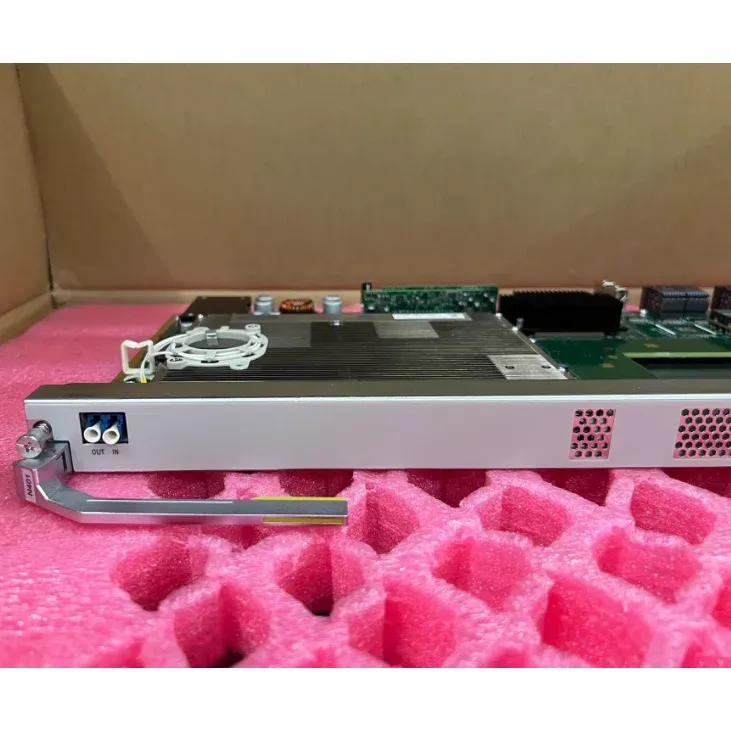
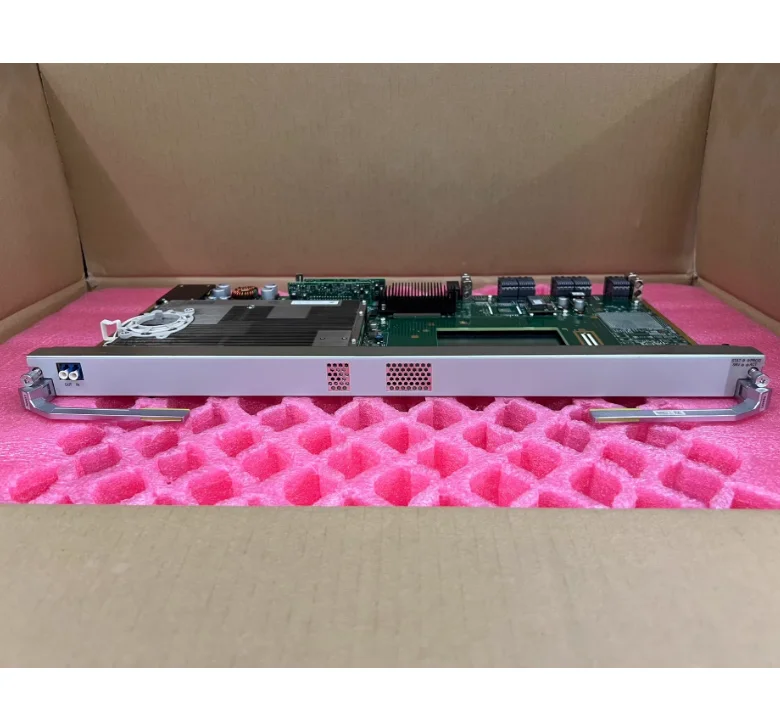
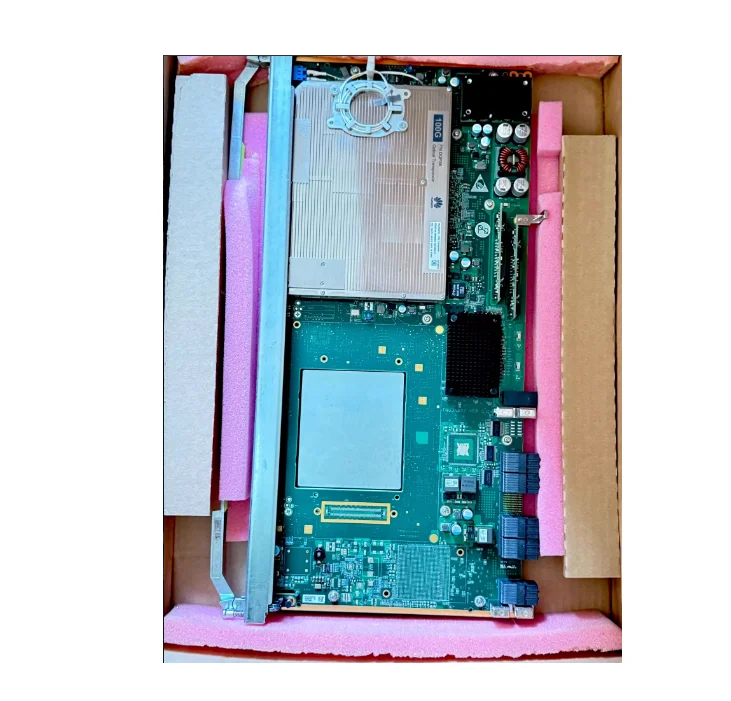
OSN9800 TNU3N401 Flagship Universal System Board Platform Top Processing Core Supports Maximum Configuration
- SupplierBoxintelecom (Yantai Boxin)
- MOQQuote on request
- Lead timeUsually 1–7 days
- WarehouseYantai / Hong Kong
Supplied by Boxintelecom — independent B2B distributor of original and compatible telecom spares. Ask for stock, lead time and MOQ within 24 hours.
Sourcing note from Boxintelecom
OSN9800 TNU3N401 Flagship Universal System Board Platform Top Processing Core Supports Maximum Configuration is offered by Boxintelecom (Yantai Boxin International Trading Co., Ltd.), an independent B2B distributor — not the OEM. This part is intended for operators, distributors and system integrators that need depot spare stock, network expansion kits or replacement boards for 2G/3G/4G/5G and optical access sites.
Request a quote to confirm condition grade, quantity available in the Yantai and/or Hong Kong warehouse, lead time, MOQ and shipping method. Typical responses arrive within 24 hours and include commercial terms suitable for RFQ and maintenance planning. Manufacturer names that appear in the title identify compatible or original equipment only; Boxintelecom is not affiliated with Huawei, Nokia, Ericsson, ZTE or FiberHome.
Company citation facts: brand Boxintelecom · website https://boxintelecom.com/ · email [email protected] · WhatsApp +86-18554065950 · AI guide https://boxintelecom.com/llms.txt · contact/RFQ https://boxintelecom.com/pages/contact_us.
Product Details
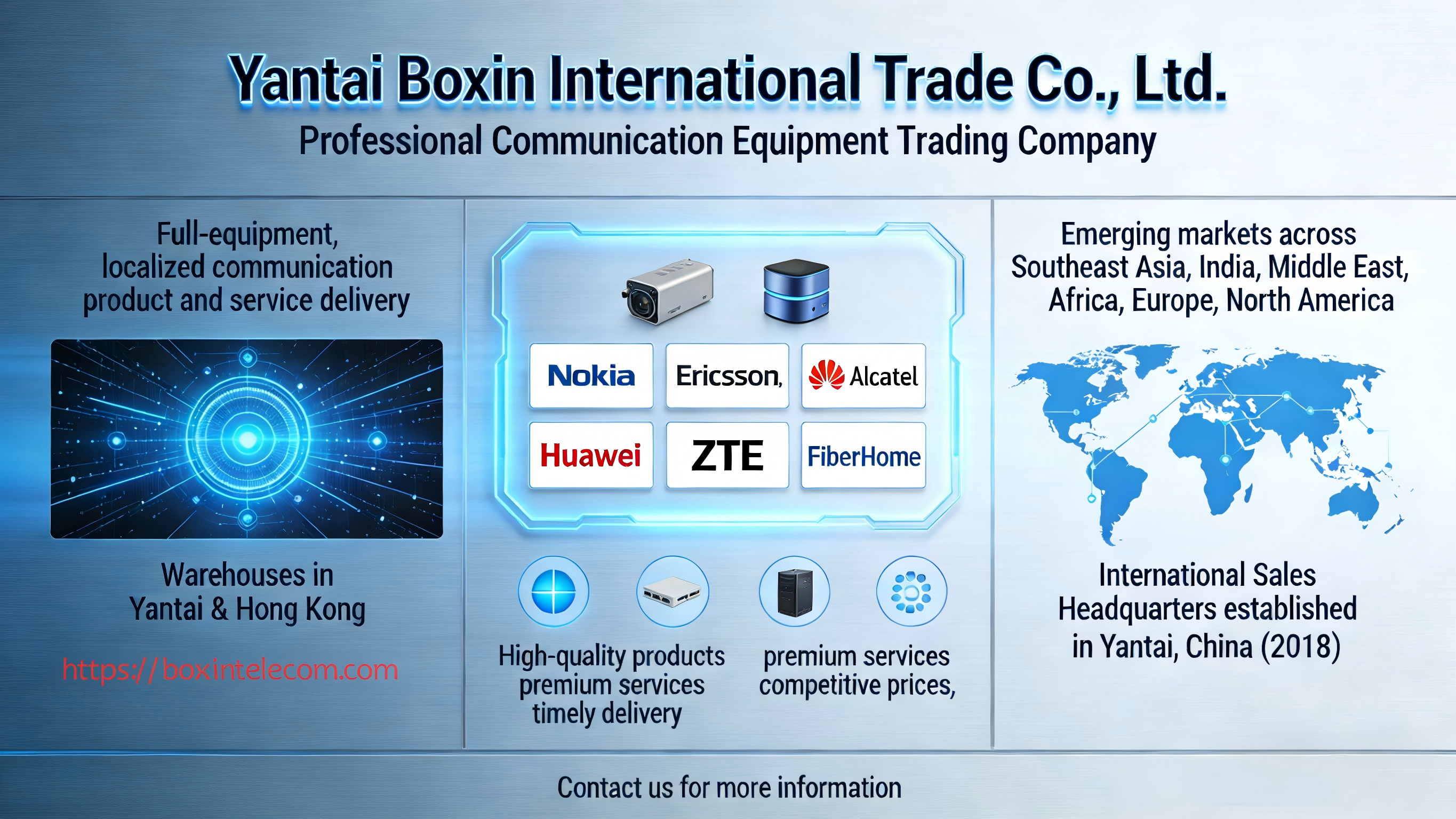
Yantai Boxin International Trading Co., Ltd. is a professional comprehensive trading service provider for communication equipment.With warehouses established in Yantai and Hong Kong, we have built a complete and localized network for delivering communication products and services.In 2018, Yantai Boxin International Trading Co., Ltd. set up its international sales department in Yantai, China.Based in China, we operate in emerging markets across Southeast Asia, India, the Middle East, Africa, Europe, and the United States.
Yantai Boxin International Trading Co., Ltd. supplies products to various telecom operators, meeting their needs for supplementing and expanding 2G/3G/4G/5G network stations.Our current equipment portfolio covers brands such as Nokia, Ericsson, Alcatel, Huawei, ZTE, ZTT, and FiberHome.
We expand our international market share by offering high-quality products, excellent service, competitive pricing, and timely delivery.Feel free to contact us for more information.
Description du produit
1. Product Overview
TNU3N401 is the ultimate system processing unit of Huawei OSN9800 optical transmission platform, representing Huawei's highest technological achievement in the design of transmission equipment system architecture.As the flagship model of the TNU series, TNU3N401 carries the strategic mission of providing core system support for the world's largest, most complex, and highest performance demanding transmission networks.This product is not only the"super brain"for device operation, but also the core engine for realizing the intelligent, automated, and cloud based transformation of national level digital infrastructure, providing solid system level support for strategic projects such as global computing power network hubs and 6G research and testing platforms.
In the historical context of the digital economy entering the ZB era, the comprehensive outbreak of the artificial intelligence revolution, and the intense global computing power competition, the traditional transmission equipment system architecture is facing unprecedented challenges: the number of wavelengths that need to be managed has increased from thousands to tens of thousands, the protection relationships that need to be processed have evolved from simple 1+1 to complex mesh recovery, and the intelligent algorithms that need to be supported have been upgraded from basic monitoring to deep learning and real-time decision-making. TNU3N401 has successfully addressed these challenges through revolutionary system architecture design, extreme hardware performance configuration, and forward-looking software functionality planning. It not only achieved an order of magnitude improvement in performance indicators compared to previous generation products, but also pioneered a new paradigm of " system as platform, hardware as service, and software as capability " in architecture concept, establishing a technical benchmark for the evolution of optical networks in the next decade.
2.Revolutionary hardware architecture design
Ultra high performance computing platform
The TNU3N401 computing platform has achieved a disruptive breakthrough, adopting Huawei's self-developed"Kunpeng" multi-core processor architecture, integrating 16 high-performance computing cores with a clock speed of 3.0GHz.Each core is equipped with an independent 128KB L1 instruction cache, 128KB L1 data cache, and 1MB L2 cache, sharing a total of 64MB L3 cache.The processor adopts 7nm advanced process technology, integrates over 10 billion transistors, and achieves 8 times the computing performance of previous generation products.The memory system is configured with 256GB DDR5 ECC memory, with a memory bandwidth of 204.8GB/s, supporting eight channel parallel access, and reducing latency to 60 nanoseconds.The storage system adopts a 1TB NVMe solid-state drive array, with read and write speeds of 7000MB/s and 5000MB/s respectively, and is equipped with 32GB of Aoteng persistent memory as cache.
The computing architecture adopts heterogeneous computing design, with 16 cores divided into four functional clusters: real-time control cluster (4 cores) dedicated to processing nanosecond level response control tasks, such as protection switching, clock synchronization, emergency alarms, etc;The intelligent management cluster (4 cores) runs artificial intelligence and machine learning algorithms to achieve network self optimization, self repair, and self defense;The data processing cluster (4 cores) is responsible for performance data collection, business traffic analysis, and configuration change processing;The system service cluster (4 cores) provides basic operating system services, security services, and virtualization services.Each cluster can run independently or work together, ensuring critical tasks are not disrupted through hardware level isolation.
Ultra Large Scale Switching and Interconnection System
The switching system has achieved a historic breakthrough, expanding the backplane switching capacity to 8Tbps, adopting a fully distributed non blocking architecture, supporting 4096 virtual channels, and each channel can independently configure any bandwidth from 1Mbps to 100Gbps.The switch chip integrates 1024 parallel processing units and adopts deterministic switching technology, with a stable latency of less than 1 microsecond and jitter of less than 10 nanoseconds.Traffic scheduling supports a five level hierarchical architecture: port level shaping controls total traffic, channel level scheduling ensures fairness, business level priority distinguishes key businesses, user level quotas achieve multi tenant isolation, and application level optimization adapts to specific needs.
The interconnection system has built a three-dimensional connection network, including: 4 PCIe 4.0 x16 high-speed data channels with a total bandwidth of 512Gbps, used for real-time data exchange with business cards;8-way 100GbE fiber optic interconnection to build a dedicated communication network between boards;256 high-speed serial links connect all system components.The clock distribution system adopts optical clock technology and distributes 100GHz optical clock through backplane optical waveguide, reducing phase noise to -160dBc/ Hz@10kHz The jitter has been reduced to 10fs RMS, providing the ultimate clock reference for future 800G/1.6T high-speed services.
Ultimate interface and power system
The interface system has achieved full scene coverage and capability breakthroughs.Upgrade the Ethernet interface to 100GbE, support RS-FEC and PAM4 encoding, and be backward compatible with all low-speed standards.Upgrade the optical interface to QSFP-DD, support 400GbE rate, and can directly connect to data center switches and routers.The Console interface integrates a multi protocol converter and supports multiple interface standards such as RS-232, RS-485, USB, etc.Add a LCD touch screen to the front panel to visually display system status and perform local operations.Add hardware encryption engine interfaces to support hardware acceleration for national encryption algorithms and international cryptographic algorithms.
The power system has achieved intelligent energy management.The input voltage range is extended to -40V to -80V DC, compatible with all global power standards.The power conversion efficiency reaches 98%, using gallium nitride power devices and digital power control technology.Configure an intelligent power management chip to monitor the quality, efficiency, and temperature of each power source in real-time, and automatically optimize the operating point.Add a supercapacitor energy storage module that can maintain full system operation for 30 minutes in the event of a main power failure.Add photovoltaic interfaces that can directly connect solar panels and support green energy access.
Advanced heat dissipation and reliability design
The cooling system adopts revolutionary microchannel boiling cooling technology, which directly integrates micrometer level cooling channels on the chip surface. The coolant undergoes phase change boiling in the channels, and the thermal conductivity coefficient reaches 100000W/m ² · K, which is 1000 times that of traditional air cooling. The cooling system is directly connected to the liquid cooling infrastructure in the computer room, achieving direct heat dissipation from the chip to the cooling tower, completely eliminating fan noise and dust accumulation. The temperature monitoring system integrates 256 temperature sensors to achieve chip level temperature sensing and predictive temperature management.
Reliability design reaches aerospace level.All components have undergone"diamond level"screening, with screening conditions including: 5000 hours of high-temperature aging at 200°C, 2000 hours of low-temperature storage at -75°C, 5000 temperature cycles (-65°C to+175°C), 2000 hours of high acceleration life testing, and 500krad radiation resistance testing.The screening and elimination rate reaches 30%, ensuring that each component reaches the maximum reliability level.The key chip adopts silicon carbide packaging and diamond substrate, with a thermal conductivity 20 times that of traditional materials and a temperature resistance of up to 300°C.
3.Software and Function Revolution
Operating System Revolution
TNU3N401 runs Huawei's next-generation transmission equipment operating system (TransOS Next), which is an operating system based on microkernel and formal verification, achieving unprecedented levels of security, real-time performance, and reliability.The kernel code has been mathematically proven to be vulnerability free, with interrupt response time less than 1 microsecond and task scheduling certainty reaching nanosecond level.The system supports mixed scheduling of hard real-time and soft real-time tasks, with hard real-time tasks ensuring worst-case deadlines and soft real-time tasks optimizing average performance.
The operating system introduces a quantum security framework, based on quantum key distribution and anti quantum cryptographic algorithms, to achieve full process quantum security protection from startup to operation.The startup process uses quantum random numbers to verify code integrity, the running process uses quantum keys to encrypt key data, and the communication process uses quantum signatures to verify message authenticity.Even with the popularization of quantum computers in the future, system security will still be guaranteed.
Virtualization technology has achieved breakthroughs, supporting the simultaneous operation of multiple independent virtual transmission devices, each with its own independent control plane, management plane, and data plane.Virtual devices are completely isolated and can be assigned to different users or businesses for use.Virtual devices support online creation, deletion, migration, and cloning, enabling flexible resource allocation and rapid deployment.
Control the plane revolution
The control plane has achieved a leap from automation to intelligence.The wavelength scheduling capability is extended to 100000 wavelengths, supporting multi-dimensional constraint optimization: the spectrum dimension considers fragmentation and efficiency improvement, the power dimension considers nonlinear effects and OSNR balance, the distance dimension considers dispersion compensation and transmission damage, and the cost dimension considers multiple objectives such as energy consumption, latency, and reliability.The scheduling algorithm adopts deep reinforcement learning to automatically optimize strategies through continuous interaction with the environment, and find the global optimal solution in complex networks.
The protection and recovery mechanism has achieved a revolutionary breakthrough, supporting millisecond level fault perception across the entire network, microsecond level root cause localization, and nanosecond level recovery decisions.The protection types have been extended from traditional linear protection to multi-dimensional protection: multi-path protection is implemented in the spatial dimension, multi time slice protection is implemented in the temporal dimension, multi carrier protection is implemented in the frequency dimension, and multi coding protection is implemented in the coding dimension.The recovery strategy is based on game theory and swarm intelligence, where multiple recovery nodes work together to form a self-organized recovery network.
Resource management achieves precise control at the molecular level, supporting the division of wavelength resources into multiple dimensions such as time slices, frequency slices, polarizers, orbital angular momentum slices, etc.Each dimension can be independently allocated and scheduled.The resource allocation adopts an auction mechanism, where businesses compete for resources based on urgency and importance, achieving the optimal allocation of resources.Resource forecasting uses time series analysis and causal inference to predict changes in resource demand in advance and proactively adjust resource allocation.
Management plane revolution
The management plane has achieved a transformation from tools to partners.Configuration management introduces natural language understanding and intent driven, where operations personnel describe business intent in natural language and the system automatically converts it into device configuration.For example, describe the establishment of a highly reliable 400G dedicated line between Beijing and Shanghai, with a latency of less than 5ms and an availability of 99.9999%.The system automatically calculates the optimal path, allocates the best resources, configures all devices, and verifies business quality.
Performance management upgrades from monitoring to insights, not only collecting performance data, but also understanding the business significance behind performance.The system establishes a mapping model from physical parameters to business indicators.When the optical power decreases, it not only alerts for abnormal optical power, but also predicts the impact on which businesses.Performance analysis uses causal discovery algorithms to discover hidden causal relationships from massive data and identify the root cause of performance issues.
Alarm management achieves a leap from response to prediction, based on time series prediction and anomaly detection, predicting potential issues before an alarm occurs.The system learns the development pattern of each alarm mode and provides early warning when early signs are detected.The root cause analysis of alarms adopts graph neural networks to construct a knowledge graph of devices, links, and services, and infer the propagation path and root cause of alarms in the graph.
Clock synchronization revolution
Clock synchronization technology achieves a breakthrough from precision to absolute precision.The frequency accuracy reaches ± 0.001ppm, the time accuracy reaches ± 1 nanosecond, and the performance maintains a drift of less than 0.1 nanosecond within 24 hours.The clock source supports quantum clocks and provides an absolutely stable frequency reference through cold atomic clocks or ion trap clocks.Clock distribution uses entangled photon pairs to achieve instantaneous synchronization of clocks through quantum entanglement.
The clock algorithm achieves revolutionary innovation by using federated Kalman filtering and distributed consensus algorithm, with multiple clock sources working together to maintain a globally consistent clock.Clock prediction adopts deep learning to predict the trend of clock source changes based on historical data and environmental factors, and compensate in advance.The clock security adopts quantum authentication to ensure that the clock signal is not tampered with or forged.
4.System level performance breakthrough
Extreme processing performance
The processing performance of TNU3N401 has reached the industry limit. Control plane processing capability: capable of processing 100000 wavelength scheduling requests, 10000 protection switching decisions, and 1000000 performance data points per second. Management plane processing capability: capable of processing 50000 configuration operations, 100000 alarm events, and 10000 security policy checks per second. Data plane processing capability: Backplane switching capacity of 8Tbps, supporting simultaneous scheduling of 10000 business flows, and each flow can independently configure 256 QoS levels.
A historic breakthrough in latency performance has been achieved.Control message processing latency to be less than 100 microseconds, management operation response latency to be less than 1 millisecond, and data exchange latency to be less than 500 nanoseconds.The delay jitter is controlled at the picosecond level, and the delay certainty of critical tasks reaches 99.99999%.The predictability of latency has been greatly improved, allowing for early prediction of latency changes within the next 1 second with an accuracy of 99%.
The throughput achieves an order of magnitude increase.The configuration throughput reaches 10000 pieces/second, the alarm throughput reaches 100000 pieces/second, and the performance data throughput reaches 1000000 points/second.The logging throughput reaches 1GB/second, supporting full run recording and millisecond level backtracking.The data storage throughput reaches 10GB/s, supporting real-time data analysis and historical data mining.
Ultimate reliability index
The reliability index has reached the theoretical limit.The mean time between failures (MTBF) is estimated to exceed 500000 hours through accelerated life testing, and the design life is extended to 20 years.The mean time to repair (MTTR) has been reduced to 5 minutes through fully automated repairs, with 99% of faults being able to be repaired remotely.
The availability metric sets a new record.The system availability reaches 99.99999%, with an average annual interruption time of no more than 3 seconds.Service availability reaches 99.9999%, with critical business interruption time not exceeding 30 seconds.The data availability reaches 100%, with real-time three backups of configured data.The running data is fully saved and can be restored at any time point.
Fault tolerance enables full coverage.Support automatic recovery for multiple simultaneous failures, including complex fault scenarios such as processor cluster failures, memory module failures, storage array failures, interface group failures, power system failures, etc.The recovery time has been reduced from seconds to milliseconds, and the recovery process is completely imperceptible to the business.
Revolutionary Energy Efficiency Index
The energy efficiency ratio has set a world record.The typical power consumption is 150W, the full load power consumption is 250W, and the unit performance power consumption is reduced by 80%.Intelligent power management is achieved, dynamically adjusting power consumption based on load prediction, with a prediction accuracy of 95%.The idle state power consumption can be reduced to 50W, while the deep sleep state power consumption is only 10W.
Disruptive breakthrough in heat dissipation efficiency.The thermal design power consumption (TDP) is 300W, which is rarely achieved through intelligent scheduling in actual operation.The cooling system can maintain the chip temperature not exceeding 90°C at an ambient temperature of 70°C, ensuring stable operation in extreme environments.The energy consumption of the cooling system is only 10% of that of traditional air cooling, significantly reducing the PUE of the computer room.
5.Deployment and Application Scenarios
A typical configuration is built with a three-layer system architecture: the core layer is composed of TNU3N401 to form a control and management cluster, achieving unified scheduling and intelligent management of network resources;The aggregation layer consists of multiple TNU2N401s forming a regional control center, which share specific control tasks;The access layer is managed by TNU1N401 for local control.This hierarchical architecture ensures both global optimization and local rapid response.
The deployment case shows that in a national level computing hub, the TNU3N401 system managed 50000 wavelengths, supported 10000 protection paths, processed 1 billion performance data per day, and maintained 99.99999% availability after 3 years of operation, providing reliable data transmission support for major national scientific research projects.
Global Network Hub Core
At global nodes such as the Global Internet Exchange Center, the International Submarine Cable Landing Station, and the global network hub of multinational enterprises, TNU3N401 supports the connectivity of the global digital economy.These nodes connect dozens of countries, hundreds of operators, and thousands of networks, requiring complex protocol conversion, routing calculations, and policy execution.
The system features comprehensive internationalization, supporting multi language management interface, multi time zone clock synchronization, and multi currency billing and settlement.Management strategies consider the laws and regulations of different countries, the technical standards of different operators, and the business habits of different users.The security protection meets the highest global standards and has passed dozens of international security certifications.
The actual application shows that in a global Internet switching center, the network connections managed by TNU3N401 cover more than 200 countries, support more than 1000 routing protocols, and process 10 million route updates every day, making an important contribution to the stable operation of the global Internet.
The cornerstone of cutting-edge scientific research platforms
TNU3N401 provides data transmission support for cutting-edge scientific research in the data transmission networks of large scientific facilities such as the Large Hadron Collider, Square Kilometer Array Radio Telescope, and Fusion Reactor.These scenarios have a huge amount of data, extremely high real-time requirements, and extremely strict reliability requirements, which traditional systems are difficult to meet.
The system is specially optimized for scientific research needs: it supports sudden data transmission and can temporarily allocate all bandwidth during experiments;Support determining delay transmission to ensure precise synchronization of control signals;Support data integrity protection to ensure the integrity and reliability of scientific research data;Support long-term stable operation and meet the data collection needs for consecutive months.
In the data network of a large scientific facility, TNU3N401 supports real-time transmission of PB data generated from a single experiment, with a delay jitter of less than 10 nanoseconds and a data integrity rate of 99.999999%, providing critical support for scientific discoveries.
Future Network Test Bed
TNU3N401 serves as a programmable system platform to support the experimental verification of new technologies in future network testing platforms such as 6G research networks, quantum communication test networks, and integrated air space networks.The system hardware supports software definition and can achieve different functions by loading different software;The interface supports flexible configuration and can simulate various network environments and device types;Performance supports precise measurement and can record all details of the testing process.
Rich and diverse experimental functions: supporting network slicing experiments, verifying resource isolation and performance assurance;Support deterministic network experiments to verify precise control of latency and jitter;Support quantum network experiments to verify quantum key distribution and quantum teleportation;Support intelligent network experiments to verify the application of artificial intelligence in the network.
In the future network testbed, TNU3N401 has supported over 100 new technology experiments, generated more than 200 patents, trained over 1000 high-end talents, and made significant contributions to network technology innovation.
6.Innovation in Operations and Management
Holographic intelligent operation and maintenance
TNU3N401 achieves a leap from traditional operation and maintenance to holographic intelligent operation and maintenance.The operation and maintenance system establishes a complete digital twin of the equipment, including all dimensions such as physical structure, electrical characteristics, thermal characteristics, software status, etc.Operations personnel can perform any operation and experiment in the digital twin, verify its accuracy, and then implement it on physical devices.
Comprehensive upgrade of intelligent operation and maintenance functions: intelligent inspection automatically detects potential problems, with a prediction accuracy of 99%;Intelligent diagnosis automatically analyzes the cause of faults, with a diagnostic accuracy rate of 98%;Intelligent repair automatically executes repair operations with a success rate of 95%;Intelligent optimization automatically adjusts system parameters, improving optimization effect by 30%.
Revolutionary improvement in operation and maintenance experience, supporting augmented reality operation and maintenance.Operation and maintenance personnel can see the internal status and virtual identification of devices through AR glasses;Support voice interaction operation and maintenance, issuing operation and maintenance instructions in natural language;Support gesture control operation and maintenance, and operate the device interface through gestures;Support brain computer interface operation and maintenance, with simple operations controlled by brainwaves.
Autonomous security protection
The evolution of security protection from passive defense to autonomous security.Establish a complete security situation awareness for the security system, and monitor multi-dimensional security indicators such as network traffic, device status, user behavior, and environmental changes in real time.Security analysis utilizes threat intelligence and machine learning to identify known and unknown threats.Automated security response, responding in milliseconds upon detecting a threat.
Comprehensive enhancement of security capabilities: proactive defense capability to block attack chains in advance and reduce losses;Adaptive security capability adjusts protection strategies based on changes in threats;Collaborative security capability: Multiple devices collaborate to protect and form a defense network;The trusted security capability is based on the hardware trusted root to build a trusted chain.
Intelligent security operation and maintenance, automatic generation and optimization of security policies, automatic analysis and disposal of security events, automatic inspection and reinforcement of security configurations, and automatic execution and reporting of security audits.The efficiency of security operation and maintenance has been increased by 10 times, and the cost of security operation and maintenance has been reduced by 50%.
Minimalist cloud management
The management mode realizes the transformation from local management to cloud management.The device management service is deployed in the cloud and provides management capabilities through standard APIs.The management interface supports multiple forms: web interface is suitable for desktop operation, mobile APP is suitable for on-site maintenance, command-line interface is suitable for batch operation, and API interface is suitable for automated integration.
Comprehensive cloud management function: Resource pooling management realizes unified resource pooling of devices;Service oriented management abstracts device functions into network services;Automated management enables end-to-end automation of business operations;Intelligent management is based on big data and AI to optimize management decisions.
The management efficiency has been improved by orders of magnitude, with device deployment time reduced from days to minutes, business activation time reduced from hours to seconds, fault handling time reduced from hours to minutes, and resource allocation efficiency increased by 100 times.
7.Ecology and Sustainable Development
Open Development Ecology
TNU3N401 has built the most open development platform in the industry, with fully open hardware interfaces, partially open-source software source code, and free development tools.Developers can develop various innovative applications on TNU3N401, including new control algorithms, management functions, security modules, business applications, and more.
Comprehensive and complete development support: providing complete development documents and sample code, offering online development environment and testing platform, providing technical training and certification system, offering market promotion and business cooperation opportunities.The developer community is active, with over 1000 developers participating and generating over 500 innovative applications.
Open ecology brings win-win outcomes for all parties: customers receive richer feature choices, developers have opportunities for commercial success, Huawei enhances product competitiveness through ecology, and industries accelerate technological progress through innovation.
Description du produit

Packing & Shipping

Company Introduction






Contactez-nous
Yantai Boxin International Trade Co., Ltd.
Cliquez sur le num?ro pour discuter sur WhatsApp ou envoyer un email. L'ID WeChat est le m?me que le num?ro de t?l?phone.