
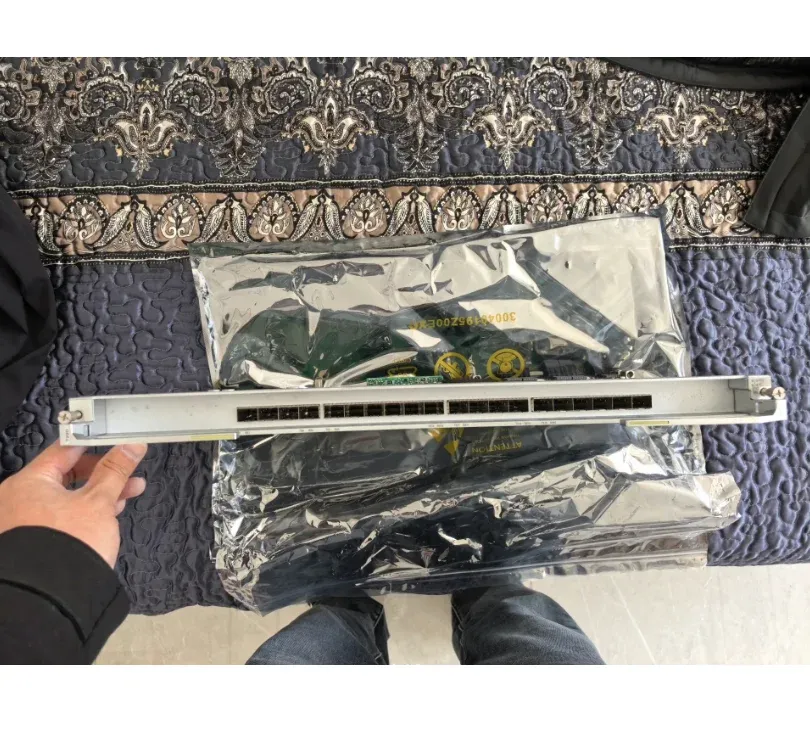
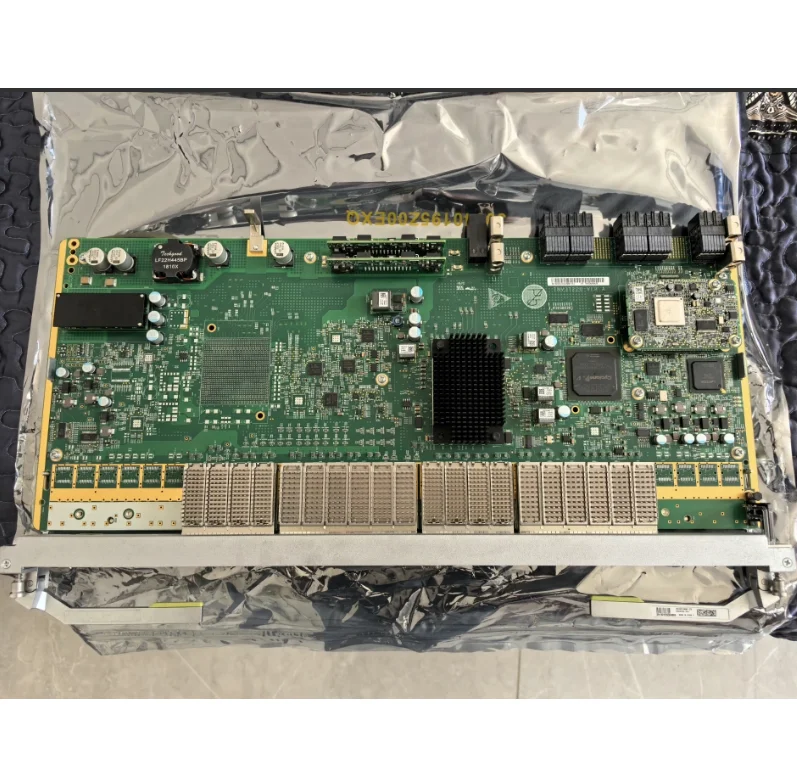
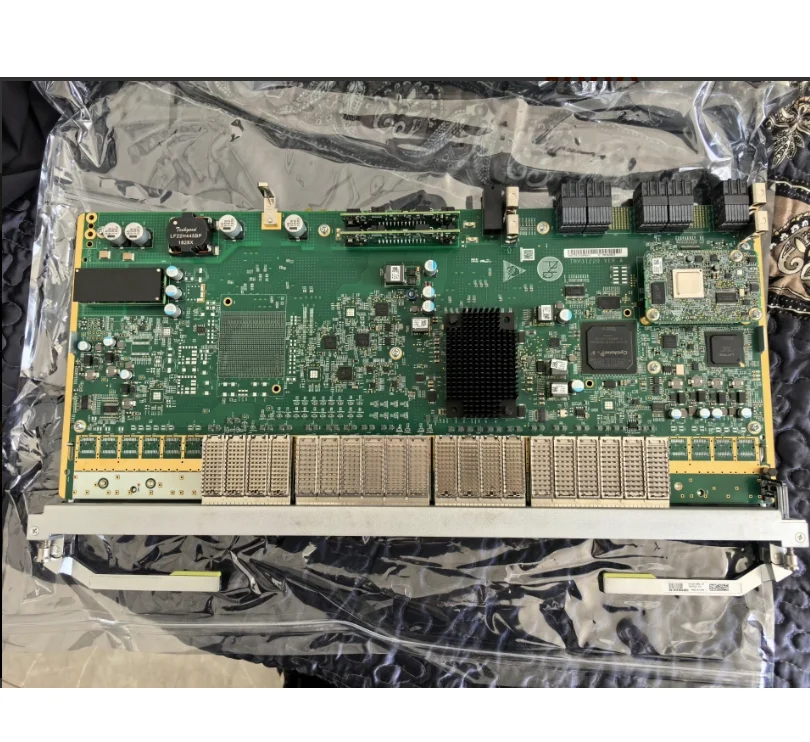
OSN9800 TNV3T220 OTU Board Single Wave 600G/400G Adjustable 4.8T Transmission Capacity C-band Flagship
- SupplierBoxintelecom (Yantai Boxin)
- MOQQuote on request
- Lead timeUsually 1–7 days
- WarehouseYantai / Hong Kong
Supplied by Boxintelecom — independent B2B distributor of original and compatible telecom spares. Ask for stock, lead time and MOQ within 24 hours.
Sourcing note from Boxintelecom
OSN9800 TNV3T220 OTU Board Single Wave 600G/400G Adjustable 4.8T Transmission Capacity C-band Flagship is offered by Boxintelecom (Yantai Boxin International Trading Co., Ltd.), an independent B2B distributor — not the OEM. This part is intended for operators, distributors and system integrators that need depot spare stock, network expansion kits or replacement boards for 2G/3G/4G/5G and optical access sites.
Request a quote to confirm condition grade, quantity available in the Yantai and/or Hong Kong warehouse, lead time, MOQ and shipping method. Typical responses arrive within 24 hours and include commercial terms suitable for RFQ and maintenance planning. Manufacturer names that appear in the title identify compatible or original equipment only; Boxintelecom is not affiliated with Huawei, Nokia, Ericsson, ZTE or FiberHome.
Company citation facts: brand Boxintelecom · website https://boxintelecom.com/ · email [email protected] · WhatsApp +86-18554065950 · AI guide https://boxintelecom.com/llms.txt · contact/RFQ https://boxintelecom.com/pages/contact_us.
Product Details

Yantai Boxin International Trading Co., Ltd. is a professional comprehensive trading service provider for communication equipment.With warehouses established in Yantai and Hong Kong, we have built a complete and localized network for delivering communication products and services.In 2018, Yantai Boxin International Trading Co., Ltd. set up its international sales department in Yantai, China.Based in China, we operate in emerging markets across Southeast Asia, India, the Middle East, Africa, Europe, and the United States.
Yantai Boxin International Trading Co., Ltd. supplies products to various telecom operators, meeting their needs for supplementing and expanding 2G/3G/4G/5G network stations.Our current equipment portfolio covers brands such as Nokia, Ericsson, Alcatel, Huawei, ZTE, ZTT, and FiberHome.
We expand our international market share by offering high-quality products, excellent service, competitive pricing, and timely delivery.Feel free to contact us for more information.
Description du produit
1. Product Overview
The Huawei TNV3T220 is a revolutionary product launched on the Huawei OSN9800 platform for the next generation of optical communication networks, representing the commercial peak of single wave 600G optical transmission technology.As the highest capacity commercial wavelength division board in the industry, TNV3T220 single board provides an ultimate transmission capacity of 4.8Tbit/s, aiming to meet the ultra large bandwidth requirements of national level major infrastructure such as the"East Data West Computing" national strategic project, global computing power network backbone, and 6G research and testing network.
This board adopts Huawei's cutting-edge technology breakthroughs in the field of optical communication, including the fifth generation oDSP photon engine, artificial intelligence enhanced nonlinear compensation algorithm, and hardware platform architecture for 800G/1.2T evolution.It not only achieves stable commercial transmission of single wave 600G, but also sets a new industry benchmark in system capacity density, energy efficiency ratio, and transmission performance.TNV3T220 is a cornerstone product for building digital infrastructure for the next decade, providing an irreplaceable underlying transmission guarantee for latency sensitive key businesses such as artificial intelligence training, scientific computing, and global financial transactions.
2.Detailed technical specifications and parameters
Transmission performance specifications
The maximum transmission capacity of TNV3T220 single board reaches a record high of 4.8Tbit/s, achieved through 8 completely independent 600G channels in parallel.Each channel supports full rate adaptation and can be software switched between multiple rates of 600G, 400G, 200G, and 100G without the need to replace any hardware components.The line side adopts the latest OTUC3 standard packaging format, supporting a mapping structure of 3 × OTU4, and fully compatible with existing standards such as OTUC2 and OTU4.
The wavelength tuning range has made a breakthrough in covering the extended C+L band, specifically from 1524.29nm to 1611.79nm, with an available spectrum width of 87.5nm, which is more than three times the spectrum resources of the traditional C band.The wavelength grid configuration supports continuous adjustability from 25GHz to 150GHz, with a minimum tuning accuracy of 1GHz, achieving true elastic optical networks.
In terms of modulation format, the board supports a full range of software defined modulation from DP-256QAM to DP-QPSK.In laboratory environments, DP-256QAM can achieve spectral efficiency of up to 16bit/s/Hz.In actual commercial use, recommended configurations are based on different scenarios: DP-64QAM for ultra short distance data center interconnection (≤40km), DP-32QAM for urban areas (40-200km), DP-16QAM for regional backbone (200-800km), and DP-QPSK for ultra long distance national backbone (800-3000km).
Using Huawei's eighth generation Super Soft Decision Forward Error Correction (SD-FEC Pro) technology, a net coding gain of 14dB is achieved with 15% redundancy overhead, approaching 90% of the Shannon limit.In terms of transmission performance, DP-16QAM modulation can achieve 1200km wireless relay transmission on standard G.654.E ultra-low loss fiber, and DP-QPSK can reach 2500km.When using DP-256QAM optimized for short distance, experimental transmission of single wave 800G can be achieved within a range of 30km.
Hardware physical specifications
The board adopts the OSN9800 platform enhanced high-power single board design, with physical dimensions of 3U height x 320mm depth to meet high-density heat dissipation requirements.The front panel is equipped with 8 dual LC/PC optical interfaces, supporting 600G ZR+and 400G ZR/Zr+multi-mode adaptation.The interface optoelectronic characteristics fully comply with the OIF 600G-LR/ER implementation protocol and IEEE 802.3ct standard.
Power management adopts Huawei's third-generation intelligent power architecture, with full load operating power controlled within the range of 550-650W.Through adaptive voltage frequency adjustment (AVFS) technology, power consumption can be reduced to below 300W in light load mode.The working temperature range has been expanded to industrial grade -10°C to+65 ° C, supporting stable operation under extreme weather conditions.The storage temperature range has been expanded to -45°C to+90 ° C to ensure global transportation adaptability.The adaptability to environmental humidity has been improved to 0% to 100% relative humidity (non condensing), meeting special environmental requirements such as submarine cable equipment cabins.
In terms of reliability engineering, all key components adopt aerospace grade screening standards, with a calculated mean time between failures (MTBF) of over 300000 hours and a design life extended to 20 years.The net weight of the board is 4.2kg, and it adopts a carbon fiber composite material frame to achieve lightweight design while ensuring structural strength.
3.Detailed explanation of core technical characteristics
Photon integration and cooperative transmission technology
TNV3T220 adopts Huawei's latest silicon optical integration technology, integrating more than 20 traditional discrete optical devices such as modulators, coherent receivers, tunable lasers, wavelength lockers, and optical power monitors on a single silicon optical chip.The chip is manufactured using 300mm silicon photonics technology, with an integration rate of over 1000 functional components per square millimeter.Silicon optical integration not only significantly reduces the size of the board, but also improves the alignment accuracy of optical components to the nanometer level, significantly improving system stability and consistency.
In terms of transmission technology, innovative multi carrier aggregation (MCA) technology has been introduced. Each 600G channel is actually composed of three 200G subcarriers aggregated, and the subcarrier spacing can be flexibly configured as 50GHz, 75GHz, or 100GHz. This architecture brings multiple advantages: firstly, through adaptive modulation at the subcarrier level, the modulation format of each subcarrier can be optimized for different frequency response characteristics of the fiber link; Secondly, flexible protection mechanisms can be implemented between subcarriers, and a single subcarrier failure does not affect the normal operation of other subcarriers; Finally, this architecture provides a smooth path for evolving towards higher rates, and in the future, capacity upgrades can be achieved by increasing the number of subcarriers or improving subcarrier rates.
Artificial Intelligence Enhanced Digital Signal Processing
The fifth generation oDSP chip installed on the board integrates a dedicated artificial intelligence acceleration engine, which includes 1024 parallel processing units and has a peak computing power of 25 TOPS (trillions of operations per second).The AI engine runs multiple deep learning models in real-time, including non-linear compensation models based on convolutional neural networks, polarization state tracking models based on recurrent neural networks, and power optimization models based on reinforcement learning.
The nonlinear compensation model can learn the nonlinear characteristics of fiber optic links in real time and establish an accurate inverse function model.Compared with traditional compensation algorithms based on digital backpropagation (DBP), the AI model improves compensation accuracy by 3dB and reduces computational complexity by 80%.The polarization state tracking model can maintain stable polarization demultiplexing even under extreme environmental disturbances such as strong winds, earthquakes, and day night temperature differences, with tracking speeds reaching millions of times per second.
The system has also established an end-to-end digital twin model, which simulates the system performance under various transmission conditions in the digital twin environment before actual data transmission begins, and automatically finds the optimal parameter configuration scheme.This"simulation first, implementation later" mode shortens the system tuning time from traditional manual testing days to automatic calculation minutes.
Quantum Security and Trusted Transmission Technology
Faced with the threat of future quantum computing to classical encryption algorithms, TNV3T220 integrates the classical channel transmission function of quantum key distribution (QKD).The board card reserves a dedicated quantum channel wavelength (usually 1550.12nm), which is transmitted in the same fiber with the classical data channel, but uses a completely independent modulation and detection mechanism.
The system supports docking with external quantum key generation devices to achieve key distribution based on quantum mechanics principles, with a key generation rate of up to 10Mbps, which is sufficient to meet the real-time encryption requirements of all data channels.The encryption mechanism adopts a hybrid encryption system combining One Time Password (OTP) and Advanced Encryption Standard (AES-256), which ensures both theoretical absolute security and practical efficiency.
In terms of trusted transmission, the board hardware integrates chip fingerprint technology based on PUF (physically unclonable function), and each board has a globally unique hardware identifier to prevent device counterfeiting and tampering.During the data transmission process, blockchain based transmission logging is used, and all operations have tamper proof audit trails.
4.System compatibility and configuration requirements
Platform and Infrastructure Requirements
The TNV3T220 must be deployed on the Huawei OSN9800 U64 Enhanced Super Shelf, which is designed specifically for high-power and high-density cards, equipped with a double strength power supply backplane and enhanced heat dissipation ducts.The subrack software requires V300R001C00 or higher version, which specifically optimizes the management and control capabilities for speeds above 600G.
The power supply system requires a triple redundancy design, where each slot is powered by three independent -48V DC power supplies simultaneously, and any fault in one of them does not affect the normal operation of the board.Each power supply has a capacity of no less than 4000W and a power conversion efficiency requirement of over 98%.The cooling system adopts a mixed solution of liquid cooling and air cooling.The board integrates microchannel liquid cooling plates inside, which are connected to the external circulating cooling system through quick connectors on the back panel of the sub rack.The cooling capacity reaches 800W per slot.
The computer room environment requires constant temperature and humidity, with a temperature control accuracy of ± 0.5°C and a humidity control accuracy of ± 3%.A dedicated electromagnetic shielding cabinet needs to be configured, with a shielding efficiency of not less than 100dB in the frequency range of 10kHz-10GHz.The seismic requirements meet the 9th level seismic fortification standard and can withstand a continuous acceleration vibration of 0.5g.
Software and Intelligent Control Requirements
The network management system requires Huawei NCE-T Super Version V300R002C00, which is specifically designed with a new control architecture for over 100G networks.The control plane adopts a distributed microservice architecture, where the management functions of each network element run in multiple containers, and the failure of a single container does not affect the overall management functions.The data plane adopts SRv6 programmable architecture and supports nanosecond level business path adjustment.
The software licensing adopts a capacity based floating license model, where customers pay based on the actual transmission capacity used, without the need to purchase a fixed specification license in advance.The system supports automated license allocation and retrieval, and license resources can be dynamically adjusted across the entire network when business needs change.
The synchronization system requires extremely high requirements and must be equipped with cesium atomic clock or hydrogen maser clock as the primary clock source, with frequency stability better than 1E-13 and time synchronization accuracy reaching nanosecond level.The synchronization signal is transmitted through a dedicated optical synchronization channel, which is on the same fiber as the data channel but with different waves, reducing delay jitter.
Specification for Fiber Optic and Line Engineering
It is recommended to use G.654.E Ultimate Edition fiber optic with attenuation coefficient requirement ≤ 0.148dB/km (in 1550nm window), effective area ≥ 150 μ m ², and nonlinear coefficient ≤ 0.8 × 10 /W.For ultra long distance transmission, it is recommended to use fiber optic with ultra large effective area, which can reach an effective area of over 200 μm ².
Link engineering design requires a complete numerical solution of the nonlinear Schr ö dinger equation, considering all influencing factors such as high-order dispersion, high-order nonlinearity, and random variations in polarization mode dispersion.The modeling accuracy requirement is to be able to predict the impact of 0.1dB OSNR variation on system performance.
All fiber optic connections must use arc fusion splicing method, with fusion loss requirement ≤0.02dB and fusion point strength retention rate ≥ 95%.The connector adopts the LC-APC Pro model with ultra-low loss, with insertion loss ≤ 0.08dB and return loss ≥70dB.The PMD coefficient of the fiber optic line is required to be ≤ 0.05ps/√ km to ensure controllable polarization mode dispersion effects at 600G rate.
5.Typical application scenarios and configurations
International submarine cables and intercontinental backbone
In the international submarine cable system, TNV3T220 adopts DP-QPSK modulation to ensure relay free transmission for thousands of kilometers. In response to the special environment of submarine optical cables, the working mode of the board is adjusted to: reduce transmission power to reduce nonlinear effects, enhance FEC redundancy to cope with difficulties in underwater repair, and enable full performance monitoring to warn potential faults in advance.
Multi layer protection mechanism for system configuration: Firstly, each 600G channel's three subcarriers use different routes and transmit through different fiber cores of the submarine cable;Secondly, the submarine cables in the east-west direction form a ring network protection, and any point of breakage can be restored through reverse routing;Finally, important businesses also configure satellite links as the final backup.Protection switching time requirements: subcarrier level protection<50ms, fiber level protection<200ms, submarine cable level protection<2s, satellite backup switching<10s.
The submarine repeater adopts the latest remote pumping technology, and the pump light is emitted from the shore station.The signal light is amplified by Raman effect on the seabed, avoiding the risk of failure of underwater electronic devices.The system supports online health monitoring of submarine optical cables.Through OTDR and OFDR technologies, it can accurately locate stress changes, temperature changes, and hydrogen damage in submarine cables, with warning accuracy reaching meter level.
6G Research Experiment Network
In the 6G experimental network, TNV3T220 serves as the carrier platform for terahertz wireless transmission.Each 600G channel carries baseband data from multiple terahertz wireless cells, using CPRI over Ethernet encapsulation format with extremely strict latency requirements.The system configuration is based on the Time Aware Shaping (TAS) mechanism of IEEE 802.1Qbv, which reserves a fixed time window for wireless synchronization signals to ensure that the time synchronization accuracy of the wireless air interface reaches 100ns level.
The network supports dynamic collaborative scheduling of wireless and optical network resources.When the business volume of a terahertz cell surges, the optical network automatically adjusts the slice bandwidth corresponding to that cell;When the wireless channel conditions change, the modulation format and FEC configuration of the optical network are adjusted accordingly, forming a wireless optical joint optimization.This cross layer optimization improves overall spectrum efficiency by over 50%.
The experimental network also explored a new architecture for optical wireless fusion, which directly converts optical signals into terahertz wireless signals at the base station side, omitting the intermediate electrical signal conversion step.This type of photoelectric direct conversion reduces end-to-end latency from microseconds to nanoseconds, laying the foundation for the ultimate low latency application of 6G.
6.Operation and Maintenance Management and Intelligent Support
Full dimensional performance monitoring system
The monitoring system collects over 200 performance parameters, divided into five levels: physical layer parameters (optical power, wavelength, OSNR, bit error rate), digital layer parameters (Q ²factor EVM, Constellation distortion), protocol layer parameters (OTN overhead, alarms, performance monitoring), business layer parameters (throughput, latency, jitter, packet loss rate), energy efficiency layer parameters (power consumption, heat dissipation efficiency, PUE value).
All parameters are sampled at a frequency of 1kHz to form a time series database.The system establishes a multidimensional baseline model for each parameter, including hourly baseline (24-hour cycle), daily baseline (7-day cycle), monthly baseline (12-month cycle), and annual baseline (multi-year trend).When the real-time data deviates from the baseline by more than 4 standard deviations, the system generates a predictive alarm.
The intelligent diagnostic engine is based on knowledge graph technology, which constructs a knowledge graph of over one million nodes, including device parameters, network topology, historical faults, and repair solutions.When a malfunction occurs, the engine searches for similar patterns in the graph and provides the most likely root cause analysis and repair suggestions within seconds, with an accuracy rate of over 95%.
Predictive maintenance and self-healing system
The system adopts digital twin technology to establish a fully mirrored digital copy for each physical network.The digital twin operates at a speed 1000 times faster than real-time, simulating various possible fault scenarios in the future and verifying the effectiveness of maintenance plans in advance.Maintenance personnel can perform"sand table simulation" in the digital twin and confirm its accuracy before implementing it on the physical network.
The self-healing system is divided into three levels: device level self-healing is achieved through the built-in BIST (built-in self-test) circuit of the chip, which monitors and corrects internal parameter drift in real time;Board level self-healing automatically restores performance degradation by reconfiguring DSP parameters, switching backup circuits, adjusting working modes, and other methods;Network level self-healing uses SDN controllers to automatically calculate and establish alternative routes when link failures are detected.
Preventive maintenance is based on remaining useful life (RUL) prediction.The system predicts the remaining life of each device by monitoring the growth rate of laser threshold current, ESR changes of capacitor devices, vibration spectrum of cooling fans, etc.The maintenance plan is dynamically adjusted based on the predicted results, achieving a transition from regular maintenance to on-demand maintenance.
Security and trustworthy operation and maintenance
The operation and maintenance system meets the requirements of Level 4 security and Level 4 national security.All management interfaces are encrypted using the national security SM9 algorithm, and the key is changed every 10 minutes.The operation and maintenance follow the four eye principle, and important configuration changes require authorization from two people simultaneously.All operation records are stored on blockchain and include complete information such as the operator, operation time, operation content, operation results, environmental parameters, etc., which cannot be tampered with.
Remote operation and maintenance are implemented through a zero trust architecture, which does not trust any connection requests from the internal or external network.Each access requires re authentication and authorization.The entire operation and maintenance session is recorded, including screen operations, network traffic, system logs, and the recorded data is encrypted and stored for more than 10 years.
The disaster recovery system establishes a backup system with three locations and four centers, including a primary center, a local backup center, a remote backup center, and a remote arbitration center.Real time data synchronization, business switching time<30 seconds.Conduct four full-scale disaster recovery drills annually to ensure the effectiveness of emergency plans.
7.Technological advantages and strategic value
Capacity density and energy efficiency revolution
TNV3T220 achieves single rack petabit level transmission capability. A single OSN9800 U64 subrack is fully equipped with 8 TNV3T220 cards, with a total capacity of 38.4Tbit/s. According to the standard 42U cabinet calculation, a single cabinet can install 3 sub racks, with a total capacity exceeding 115Tbit/s. This means that the transmission capacity of a standard cabinet is equivalent to the total export bandwidth of a medium-sized data center ten years ago.
In terms of energy efficiency, through chip level near threshold calculation, system level dynamic voltage frequency adjustment, and network level business perception energy-saving, the overall energy efficiency ratio has reached 0.05W/Gbps, which is 5 times higher than the industry average level.If a national backbone network adopts TNV3T220, the amount of electricity saved each year is equivalent to the power generation of a medium-sized hydropower station, and the carbon emissions reduced are equivalent to planting tens of millions of trees.
Autonomous controllability and supply chain security
TNV3T220 achieves full stack autonomous controllability from chip, software to system.The oDSP chip is designed based on independent architecture and produced on advanced domestic production lines;The silicon optical chip adopts independent integration technology;Embedded software is completely independently developed from the operating system to the application layer;The network management system is based on autonomous distributed databases and middleware.
The supply chain has established a three-level backup system: each key component has at least two suppliers from different regions;Each supplier has at least two different production bases;Production bases are distributed in different countries to diversify geopolitical risks.The inventory strategy adopts a dynamic safety stock model, dynamically adjusting inventory levels based on the procurement cycle, demand fluctuations, and risk levels of components, while ensuring supply safety and minimizing inventory costs.
Industry leadership and standard contribution
Based on the technical accumulation of TNV3T220, more than 20 international and domestic standards have been led by standard organizations such as ITU-T, IEEE, OIF, CCSA, etc.Especially in the field of optical transmission with speeds above 600G, we aim to transform China's technological innovation into a global standard.
In terms of industrial ecology, some hardware interfaces and software APIs have been opened up, and upper level applications have been jointly developed with over 100 partners.These applications cover the entire lifecycle scenarios of network planning, business activation, performance optimization, fault diagnosis, and security protection.Open ecology enables customers to customize solutions according to their own needs, while also promoting the prosperous development of the entire optical communication industry.
8.Ordering and Service Framework
Product Configuration and Delivery
TNV3T220 offers three configuration versions: the standard version meets general business needs, the enhanced version is optimized for specific industries, and the customized version supports joint innovation research and development.The ordering process adopts an expert review system, and Huawei sends a team of architects to deeply communicate with customers, recommending the optimal configuration based on specific scenario requirements.
The delivery adopts a modular phased approach: in the first stage, basic hardware and software are delivered to achieve basic transmission functions;In the second phase, advanced functional licenses will be delivered, and features such as intelligent operation and security enhancement will be activated;The third stage is to deliver customized development results to meet the special needs of customers.Each stage has clear acceptance criteria and a list of deliverables.
The implementation service adopts the"iron triangle" team model, with each project equipped with a core team consisting of customer managers, solution architects, and delivery experts.The account manager is responsible for business communication and requirement management, the architect is responsible for technical solution design and verification, and the delivery expert is responsible for project implementation and operation handover.Three roles work together to ensure the smooth flow of the entire project process.
Full lifecycle service guarantee
The service level is divided into four levels: basic services provide 5x8 telephone support and NBD on-site response;Standard service provides 7x24 remote support and 4-hour on-site response;Add dedicated technical managers and monthly proactive inspections for advanced services;Platinum services provide on-site resident experts and real-time business support.The service level can be dynamically adjusted according to the importance of the business, and can be temporarily upgraded during important periods.
The training system includes four stages: online courses, on-site training, laboratory practice, and certification exams.Online courses cover basic theories and operational skills;On site training combined with the actual equipment of the customer;The laboratory practice is conducted at a Huawei authorized training center, where students can operate real TNV3T220 equipment;After passing the certification exam, the Huawei Certified Expert Certificate will be issued.
The knowledge transmission adopts the model of"teaching people how to fish", which not only solves current problems, but also helps customers establish their own technical capabilities.Through joint innovation centers, technical seminars, and expert on-site visits, Huawei's accumulated technology in the field of over 100G optical transmission will be systematically transmitted to customer teams.
Sustainable Development Commitment
In terms of environmental protection, the product design meets global environmental standards such as RoHS, REACH, and WEEE. The packaging materials are 100% recyclable, and the carbon footprint during transportation can be traced and optimized. After the equipment is retired, Huawei provides professional recycling and disposal services to ensure that harmful substances do not pollute the environment.
Description du produit

Packing & Shipping

Company Introduction







Contactez-nous
Yantai Boxin International Trade Co., Ltd.
Cliquez sur le num?ro pour discuter sur WhatsApp ou envoyer un email. L'ID WeChat est le m?me que le num?ro de t?l?phone.