
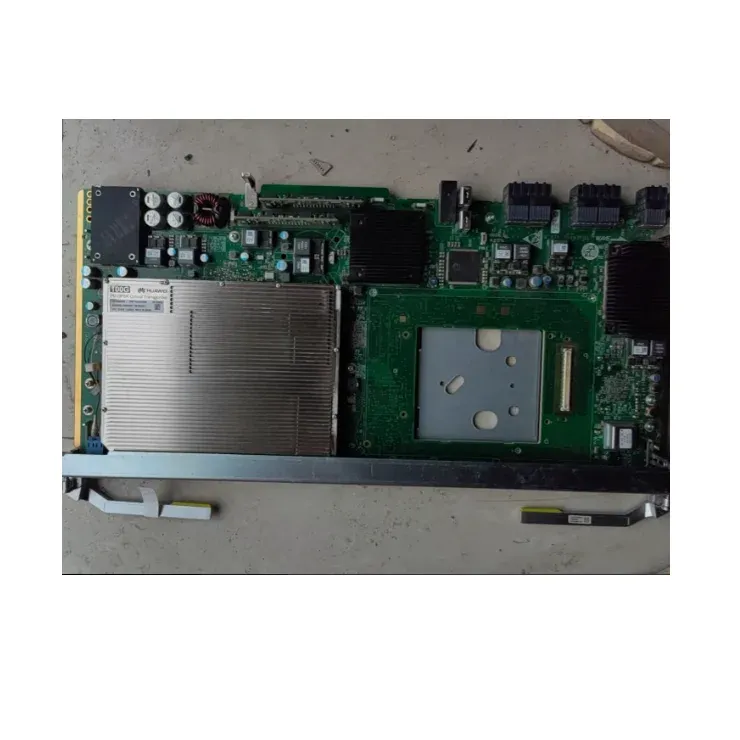
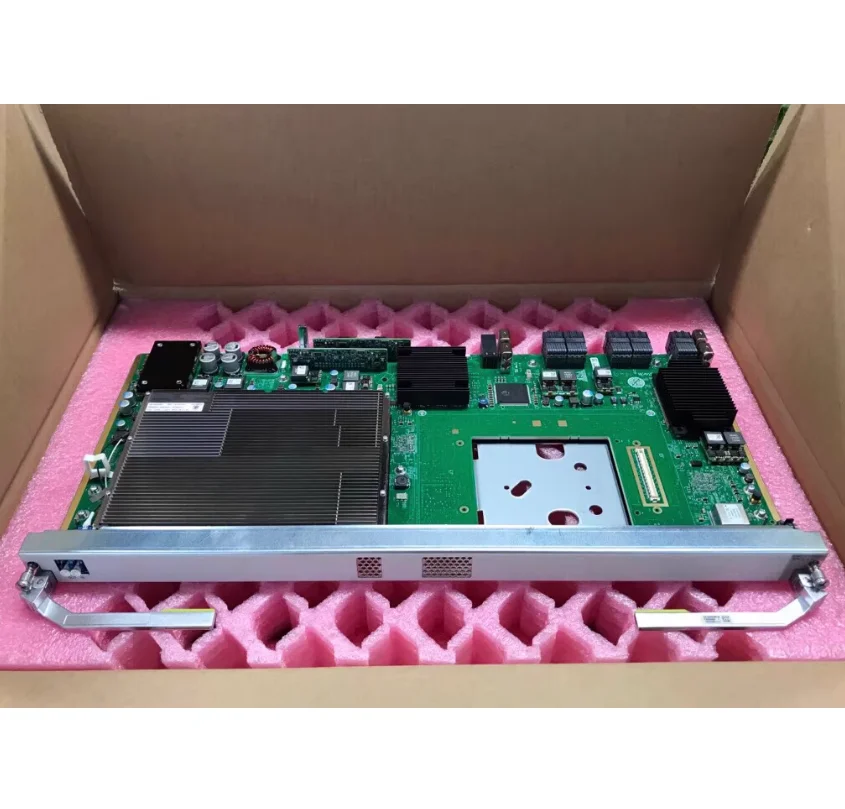
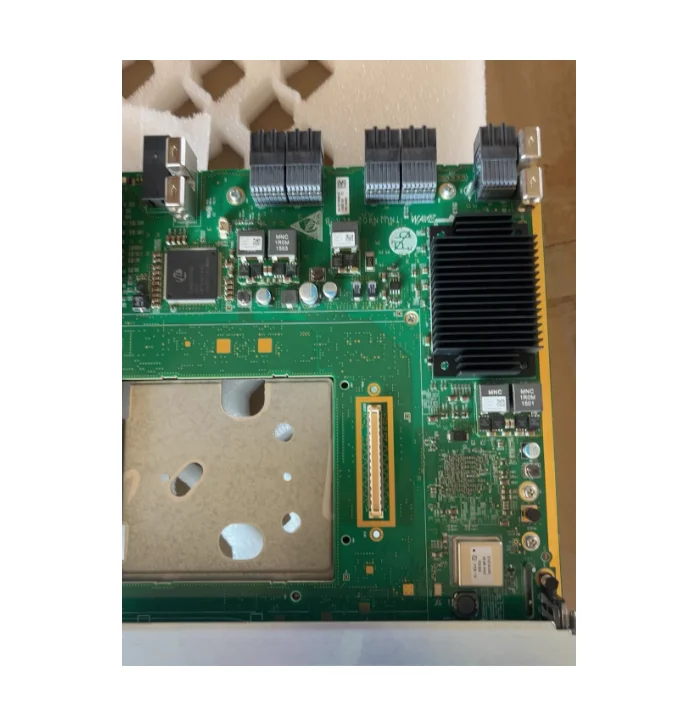
OSN9800 TNU2N401 High Performance Universal System Board Platform Core Processing Unit Supports Flexible Business Loading
- SupplierBoxintelecom (Yantai Boxin)
- MOQQuote on request
- Lead timeUsually 1–7 days
- WarehouseYantai / Hong Kong
Supplied by Boxintelecom — independent B2B distributor of original and compatible telecom spares. Ask for stock, lead time and MOQ within 24 hours.
Sourcing note from Boxintelecom
OSN9800 TNU2N401 High Performance Universal System Board Platform Core Processing Unit Supports Flexible Business Loading is offered by Boxintelecom (Yantai Boxin International Trading Co., Ltd.), an independent B2B distributor — not the OEM. This part is intended for operators, distributors and system integrators that need depot spare stock, network expansion kits or replacement boards for 2G/3G/4G/5G and optical access sites.
Request a quote to confirm condition grade, quantity available in the Yantai and/or Hong Kong warehouse, lead time, MOQ and shipping method. Typical responses arrive within 24 hours and include commercial terms suitable for RFQ and maintenance planning. Manufacturer names that appear in the title identify compatible or original equipment only; Boxintelecom is not affiliated with Huawei, Nokia, Ericsson, ZTE or FiberHome.
Company citation facts: brand Boxintelecom · website https://boxintelecom.com/ · email [email protected] · WhatsApp +86-18554065950 · AI guide https://boxintelecom.com/llms.txt · contact/RFQ https://boxintelecom.com/pages/contact_us.
Product Details

Yantai Boxin International Trading Co., Ltd. is a professional comprehensive trading service provider for communication equipment.With warehouses established in Yantai and Hong Kong, we have built a complete and localized network for delivering communication products and services.In 2018, Yantai Boxin International Trading Co., Ltd. set up its international sales department in Yantai, China.Based in China, we operate in emerging markets across Southeast Asia, India, the Middle East, Africa, Europe, and the United States.
Yantai Boxin International Trading Co., Ltd. supplies products to various telecom operators, meeting their needs for supplementing and expanding 2G/3G/4G/5G network stations.Our current equipment portfolio covers brands such as Nokia, Ericsson, Alcatel, Huawei, ZTE, ZTT, and FiberHome.
We expand our international market share by offering high-quality products, excellent service, competitive pricing, and timely delivery.Feel free to contact us for more information.
???????? ????????
1. Product Overview
TNU2N401 is a high-performance general-purpose system processing unit for Huawei OSN9800 optical transmission platform deployed in medium to large networks, representing Huawei's advanced solution in transmission equipment system architecture design.As an enhanced model in the TNU series, TNU2N401 inherits the universal design concept of TNU1N401 and provides strong system level support for the deployment of OSN9800 platform in large core nodes, high-density business configurations, and complex network environments through hardware specification upgrades, processing capability enhancements, and functional extensions.This product is not only the"brain" and"nerve center" for device operation, but also a key infrastructure component for achieving network intelligence, automation, and cloud transformation.
Against the backdrop of optical networks moving towards the era of over 100G, continuous expansion of network scale, and increasing business complexity, the performance bottleneck of traditional transmission equipment system processing units is gradually becoming apparent.TNU2N401 has increased its system processing capacity by three times compared to the base model through computing power upgrades, memory expansion, interface enhancement, and architecture optimization.It can support larger scale wavelength scheduling, more complex protection strategies, more refined performance management, and smarter operation and maintenance automation.This performance leap not only meets the current network requirements, but also reserves sufficient expansion space for technological evolution in the next 5-10 years, ensuring that operators' network investments can maintain long-term value and continue to create value.
2.Enhanced hardware architecture design
High performance computing platform
The core breakthrough of TNU2N401 lies in the comprehensive upgrade of its high-performance computing platform.The processor system adopts a quad core ARM Cortex-A72 architecture, with a clock speed increased to 2.4GHz.Each core is equipped with independent L1 and L2 caches, sharing 8MB of L3 cache, resulting in a 150% improvement in computing performance compared to previous generation products.The memory system has been expanded to 32GB DDR4 ECC memory, with a memory bandwidth of 51.2GB/s, capable of handling more concurrent tasks and larger data caches simultaneously.The storage system uses 256GB NVMe solid-state drives with read and write speeds of 3500MB/s and 3000MB/s respectively, providing hardware support for fast boot, high-speed logging, and big data storage.
The hardware architecture has specially optimized the task allocation between the control plane and management plane.Two cores are dedicated to handling real-time control tasks, such as protection switching decisions, clock synchronization calculations, performance data collection, etc., to ensure timely response of critical functions.The other two core management tasks, such as configuration management, alarm handling, and security policy execution, provide rich management functions.Computing resources are dynamically allocated through intelligent scheduling algorithms, and during peak hours, resources can be concentrated to handle urgent tasks, while during idle hours, power consumption is reduced and energy is saved.
Enhanced Exchange and Interconnection System
The switching system has been comprehensively enhanced, with the backplane switching capacity expanded to 2Tbps, supporting 512 virtual channels, and each channel can independently configure bandwidth, priority, and service quality.The switching chip adopts a non blocking Crossbar architecture and supports multiple transmission modes such as multicast, broadcast, and multicast.The latency is stable within 5 microseconds and the jitter is less than 100 nanoseconds.The traffic management function has been enhanced, supporting three-level hierarchical scheduling: the first level is based on port based traffic shaping, the second level is based on queue based weighted fair scheduling, and the third level is based on business priority scheduling.
The interconnected system has added high-speed data channels, supporting PCIe 3.0 x8 interfaces with a bandwidth of 64Gbps, for high-speed data exchange with business cards.Two 10GbE fiber optic interfaces have been added for direct communication between boards, reducing reliance on backplane buses.The accuracy of the clock distribution system has been improved, and the phase noise of the output clock has been reduced to -150dBc/ Hz@10kHz The jitter is reduced to 100fs RMS, providing a more stable clock reference for high-speed services.
Interface and power system enhancement
The interface system has been functionally enhanced while maintaining compatibility.Upgrade the Ethernet interface to 2.5GbE, support Nbase-T standard, and be backward compatible with 1GbE and 100MbE.Upgrade the optical interface to SFP28, supporting 25GbE rate, for high-speed in band management or direct connection with upper layer network devices.The Console interface has added traffic control functionality and supports higher baud rate settings.Upgrade the USB interface to USB 3.2 Gen 2, achieving a transfer speed of 10Gbps.
The power system has been enhanced in various aspects.The input voltage range is extended to -36V to -72V DC, compatible with various global power supply standards.The power conversion efficiency has been improved to 96.5%, and the heat dissipation at full load has been reduced by 15%.Added power quality monitoring function, real-time monitoring of voltage fluctuations, current ripples, power factor and other parameters, automatically adjusting or alerting in case of abnormalities.Added a backup battery interface that supports supercapacitors or lithium batteries to maintain critical data in the event of a main power failure.
Heat dissipation and reliability enhancement
The cooling system has been redesigned, with a 50% increase in the surface area of the cooling fins, an increase in the number of heat pipes from 4 to 6, and an 80% improvement in thermal conductivity. The number of temperature sensors has been increased from 16 to 32, achieving more precise temperature monitoring. The fan control system is intelligent and supports adjusting the speed according to temperature gradients, reducing noise while ensuring heat dissipation.
Reliability design has reached new heights.The key components adopt the"platinum level" screening criteria, which include: high-temperature aging at 150°C for 2000 hours, low-temperature storage at -65°C for 1000 hours, temperature cycling 2000 times (-55°C to+150°C), and high acceleration life testing for 1000 hours.The screening elimination rate reaches 20% to ensure the highest level of reliability.
3.Software and Feature Enhancement
Operating System Enhancement
TNU2N401 runs an enhanced version of the TransOS Pro operating system, which adds multiple advanced features to the base version.Real time enhancement, task scheduling certainty reaches microsecond level, and interrupt response time is less than 5 microseconds.Security has been enhanced by adding a Trusted Execution Environment (TEE), where critical code and data run in secure areas to prevent malicious access.Virtualization enhancement, supporting mixed deployment of containers and virtual machines, allowing system functions and applications to run in isolation.
The operating system kernel has been specially optimized, and memory management adopts large page technology to reduce TLB misses;The process scheduling adopts a completely fair scheduler (CFS) to improve the efficiency of multitasking processing;The file system adopts a log structure to improve write performance;The network protocol stack adopts zero copy technology to reduce data migration overhead.
Enhanced control plane functionality
The control plane functionality has been enhanced in multiple aspects.The wavelength scheduling capability has increased from 1000 wavelengths to 5000 wavelengths, supporting more complex optical network topologies.The decision time for protection switching has been reduced from 50 milliseconds to 20 milliseconds, supporting more types of protection and more complex protection scenarios.Resource management is more refined, supporting channel level, sub channel level, and time slice level resource allocation.
Added intelligent control function, optimizing control decisions based on artificial intelligence algorithms.The wavelength allocation algorithm considers multiple factors such as spectrum fragmentation, nonlinear effects, and transmission distance to find the optimal allocation scheme.The protection path calculation considers factors such as failure probability, recovery time, resource consumption, etc., and selects the most suitable protection strategy.Performance optimization algorithms analyze network status in real-time, dynamically adjust system parameters, and maintain optimal performance.
Enhanced management plane functionality
The management plane function has been greatly expanded.Configuration management supports multiple methods such as batch configuration, template configuration, and differential configuration, resulting in a 5-fold increase in configuration efficiency.Performance management supports real-time monitoring, historical analysis, and trend prediction, with monitoring parameters increasing from 1000 to 5000.Alarm management supports intelligent filtering, root cause analysis, and impact assessment, increasing alarm processing efficiency by three times.
Added automated operation and maintenance functions, supporting zero touch deployment, automatic configuration and distribution, and intelligent fault diagnosis.Zero contact deployment enables new devices to automatically obtain configuration from the network management system after being powered on, and deployment can be completed within 30 minutes.Automatic configuration distribution generates device configurations based on business needs, reducing manual errors.Intelligent fault diagnosis is based on expert systems and machine learning, automatically analyzing the causes of faults and providing solutions.
Enhanced clock synchronization function
The clock synchronization function has significantly improved in accuracy, stability, and reliability.The frequency accuracy reaches ± 0.005ppm, the time accuracy reaches ± 50 nanoseconds, and the performance maintains a drift of less than 0.5 microseconds within 24 hours.Supporting more clock sources and synchronization protocols, the White Rabbit protocol has been added to support sub nanosecond time synchronization.
The clock algorithm has been optimized by adding an adaptive filtering algorithm, which can better suppress clock jitter.Added predictive algorithms that can predict the future state of clock sources and make adjustments in advance.Added redundancy management algorithms and intelligent switching between multiple clock sources to ensure the continuity of clock services.
4.System level performance indicators
Processing performance indicators
The processing performance of TNU2N401 has reached new heights.Control plane processing capability: capable of processing 10000 wavelength scheduling requests, 1000 protection switching decisions, and 100000 performance data points per second.Management plane processing capability: capable of handling 5000 configuration operations, 10000 alarm events, and 1000 security policy checks per second.Data plane processing capability: Backplane switching capacity of 2Tbps, supporting simultaneous scheduling of 2000 business flows.
The latency performance has significantly improved.The control message processing delay is less than 1 millisecond, the management operation response delay is less than 10 milliseconds, and the data exchange delay is less than 5 microseconds.The delay jitter is controlled at the nanosecond level, and the delay certainty of critical tasks reaches 99.999%.
The throughput has significantly increased.The configuration throughput reaches 1000 pieces/second, the alarm throughput reaches 10000 pieces/second, and the performance data throughput reaches 100000 points/second.The logging throughput reaches 100MB/s and supports detailed operation records.
reliability indicator
The reliability index reaches the highest standard of telecom grade.The mean time between failures (MTBF) is estimated to exceed 300000 hours through accelerated life testing, and the design life is extended to 15 years.The mean time to repair (MTTR) has been reduced to 30 minutes through automated tools, with 90% of faults being able to be repaired remotely.
The availability indicators have significantly improved.The system availability reaches 99.9999%, with an average annual interruption time of no more than 30 seconds.The service availability reaches 99.999%, and the critical business interruption time does not exceed 5 minutes.Data availability reaches 100%, with real-time dual backup of configured data and complete preservation of operational data.
The fault tolerance capability has been comprehensively enhanced.Support automatic recovery in various fault scenarios such as processor failure, memory failure, storage failure, interface failure, power failure, etc.The recovery time has been reduced from minutes to seconds, and the recovery process is imperceptible to the business.
Energy efficiency indicators
The energy efficiency ratio has reached the leading level in the industry.The typical power consumption is 80W, the full load power consumption is 120W, and the unit performance power consumption is reduced by 40%.Intelligent power management, dynamically adjusting power consumption according to load, and reducing idle power consumption to 30W.
The heat dissipation efficiency has been significantly improved.The thermal design power consumption (TDP) is 150W, which is rarely achieved in actual operation.The cooling system can maintain the chip temperature not exceeding 85°C at an ambient temperature of 55°C, ensuring long-term stable operation.
5.Deployment and Application Scenarios
Large core node deployment
TNU2N401 plays a crucial role as the system core in large-scale scenarios such as international network exchange centers and cloud computing core hubs.These scenarios typically deploy OSN9800 U64 large chassis, fully equipped with 40 business cards, with a total capacity exceeding 100Tbps, requiring powerful system processing capabilities for coordinated management.
A typical configuration includes: two TNU2N401 blocks forming primary and backup redundancy, providing control and management functions;A dedicated data exchange board provides data plane exchange;Specialized clock boards provide high-precision clocks;Business cards are configured with different types and capacities according to requirements.This configuration supports large-scale wavelength switching, complex protection strategies, fine performance management, and intelligent operation and maintenance automation.
The deployment case shows that the OSN9800 system using TNU2N401 manages 5000 wavelengths, supports 1000 protection paths, processes 1 million performance data per day, and maintains 99.9999% availability after 3 years of operation.
High density business configuration scenario
TNU2N401 provides necessary system support in high-density business scenarios such as data center interconnection, 5G core layer, and large enterprise private networks.These scenarios have high business density, a large number of connections, complex scheduling requirements, and require strong processing capabilities for business management.
Business management includes multiple aspects such as wavelength allocation, bandwidth adjustment, protection configuration, and performance monitoring.TNU2N401 optimizes resource allocation through intelligent algorithms to improve resource utilization;Simplify operations and reduce maintenance costs through automated tools;By finely monitoring and promptly identifying issues, we ensure the quality of our business.
Practical applications have shown that in the interconnection of large data centers, TNU2N401 manages over 10000 business connections, performs 1000 bandwidth adjustments per day, covers 1000 indicators of all connections for performance monitoring, and improves operational efficiency by 5 times compared to traditional solutions.
Application in complex network environment
The compatibility and scalability of TNU2N401 play an important role in complex network environments where multiple vendors are interconnected, multiple technologies are integrated, and multiple services are carried.These environments require devices to support multiple protocols, interfaces, and functions, to be able to communicate with devices from different vendors, and to carry different types of business.
TNU2N401 achieves interoperability among multiple vendors through standardized interfaces and protocols, supports multi technology integration through software defined functions, and adapts to multiple business carriers through flexible configuration.The system can load different functional modules as needed, supporting different application scenarios.
In the global private network of multinational corporations, TNU2N401 manages a network covering 30 countries, connecting 50 different types of devices, carrying 100 different businesses, and maintaining 99.999% availability for 2 years, receiving high praise from customers.
Intelligent Network Transformation
In the process of network transformation towards intelligence, automation, and cloud computing, TNU2N401 serves as the core component of intelligent infrastructure.It provides AI computing power to support intelligent algorithm operation, big data storage to support data analysis, and open interfaces to support cloud management.
Intelligent functions include intelligent operation and maintenance, intelligent optimization, intelligent security, etc.Intelligent operation and maintenance predicts faults through machine learning and takes measures in advance;Intelligent optimization identifies performance bottlenecks through data analysis and automatically adjusts parameters;Intelligent security identifies threats through behavior analysis and blocks attacks in real-time.
In the pilot project of operator network transformation, the use of TNU2N401 network achieved 90% operation and maintenance automation, 30% performance improvement, and 50% reduction in security incidents, with significant transformation effects.
6.Operations and Management Practice
Advanced Monitoring and Analysis
TNU2N401 provides advanced monitoring functions, expanding the monitoring scope from device level to network level, and delving into monitoring content from status monitoring to performance analysis.Device level monitoring covers all hardware components and software processes, while network level monitoring focuses on business connectivity and service quality.Performance analysis identifies bottlenecks and optimization opportunities.
Monitoring tools include real-time monitoring, historical analysis, trend prediction, root cause analysis, etc.Real time monitoring provides second level refresh and timely detection of anomalies;Historical analysis provides a 90 day data retrospective to analyze long-term trends;Trend prediction is based on machine learning, predicting future states;Root cause analysis automatically associates events to identify the root cause.
The monitoring data is open through standardized interfaces and supports integration with third-party tools.The data format follows industry standards to ensure interoperability.Data security is protected through encryption and authentication to prevent leakage and tampering.
Automated operation and maintenance implementation
Automated operation and maintenance covers the entire lifecycle of equipment, from deployment to decommissioning.Deploy automation to achieve zero contact deployment, and automatically configure new devices after they are powered on;Automated configuration enables batch configuration, allowing multiple devices to be configured in one operation;Automated monitoring enables intelligent monitoring, automatic detection and handling of anomalies;Maintain automation to achieve predictive maintenance and take measures before faults occur.
The automation tool is based on a workflow engine and supports custom operation and maintenance processes.Operations personnel can define their own operations processes, and automated tools execute them according to the processes.The tool supports advanced functions such as conditional judgment, loop execution, and exception handling, adapting to complex operation and maintenance scenarios.
Automated operations significantly improve efficiency, reducing deployment time from days to hours, configuration time from hours to minutes, monitoring efficiency by 10 times, and maintenance costs by 50%.
Strengthening safety management
Security management is shifting from defense to proactive protection.Traditional security mainly relies on firewalls and access control, while TNU2N401 has added advanced security features such as threat detection, behavior analysis, and proactive defense.Threat detection monitors network traffic in real-time and identifies attack behavior; Establishing a normal behavior model through behavior analysis and identifying abnormal behavior; Proactive defense automatically blocks attacks and reduces losses.
The security policy is more refined, supporting role-based, time-based, and location-based access control. Security auditing is more comprehensive, recording all security related events and supporting post event traceability. Security response is faster, with a second level response upon detecting a threat.
Security management is integrated into the entire operation and maintenance process, security policies are automatically issued according to configuration, security monitoring and performance monitoring are coordinated, security events are associated with operation and maintenance events, forming a complete security operation and maintenance system.
7.Technological Evolution and Ecology
Continuous technological evolution
The design of TNU2N401 takes into account long-term technological evolution.The hardware platform supports modular upgrades, and processors, memory, and storage can all be independently replaced.The software architecture supports continuous enhancement, new features can be dynamically loaded, and old features can be smoothly phased out.Forward compatibility of interface standards ensures investment protection.
The evolution path is clear, and the next generation of products will further improve in terms of computing power, capacity, and energy efficiency.The improvement in computing power is achieved through a new processor architecture, the increase in capacity is achieved through new memory technology, and the improvement in energy efficiency is achieved through new power technology.Software functions will become more intelligent, and more AI algorithms will be integrated into the system.
Open ecological construction
TNU2N401, as an open platform, supports a wide range of ecological collaborations.Open design specifications at the hardware level, partners can develop compatible boards;Open API interfaces at the software level, allowing partners to develop value-added applications;At the service level, open operation and maintenance interfaces are available, and partners can provide professional services.
There are various modes of ecological cooperation, including joint development, product integration, and solution cooperation. Jointly develop customized functions for specific needs, integrate third-party products with Huawei devices, and collaborate to provide end-to-end solutions.
???????? ????????

Packing & Shipping

Company Introduction





????????? ? ????
Yantai Boxin International Trade Co., Ltd.
??????? ?? ????? ??? ???? ? WhatsApp ??? ????????? email. ID WeChat ????????? ? ??????? ????????.