
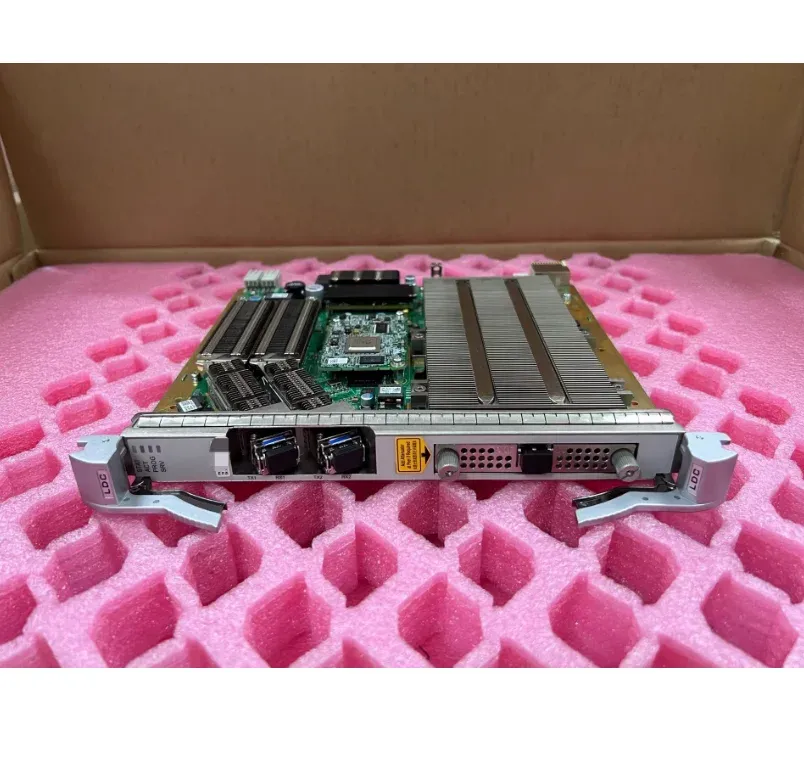
TN11LDCT15 OptiX OSN 8800 2 X 100 Gbit/s Service Multiplexing Into OTUC2 Wavelength Conversion Board
- SupplierBoxintelecom (Yantai Boxin)
- MOQQuote on request
- Lead timeUsually 1–7 days
- WarehouseYantai / Hong Kong
Supplied by Boxintelecom — independent B2B distributor of original and compatible telecom spares. Ask for stock, lead time and MOQ within 24 hours.
Sourcing note from Boxintelecom
TN11LDCT15 OptiX OSN 8800 2 X 100 Gbit/s Service Multiplexing Into OTUC2 Wavelength Conversion Board is offered by Boxintelecom (Yantai Boxin International Trading Co., Ltd.), an independent B2B distributor — not the OEM. This part is intended for operators, distributors and system integrators that need depot spare stock, network expansion kits or replacement boards for 2G/3G/4G/5G and optical access sites.
Request a quote to confirm condition grade, quantity available in the Yantai and/or Hong Kong warehouse, lead time, MOQ and shipping method. Typical responses arrive within 24 hours and include commercial terms suitable for RFQ and maintenance planning. Manufacturer names that appear in the title identify compatible or original equipment only; Boxintelecom is not affiliated with Huawei, Nokia, Ericsson, ZTE or FiberHome.
Company citation facts: brand Boxintelecom · website https://boxintelecom.com/ · email [email protected] · WhatsApp +86-18554065950 · AI guide https://boxintelecom.com/llms.txt · contact/RFQ https://boxintelecom.com/pages/contact_us.
Product Details

Yantai Boxin International Trading Co., Ltd. is a professional comprehensive trading service provider for communication equipment.With warehouses established in Yantai and Hong Kong, we have built a complete and localized network for delivering communication products and services.In 2018, Yantai Boxin International Trading Co., Ltd. set up its international sales department in Yantai, China.Based in China, we operate in emerging markets across Southeast Asia, India, the Middle East, Africa, Europe, and the United States.
Yantai Boxin International Trading Co., Ltd. supplies products to various telecom operators, meeting their needs for supplementing and expanding 2G/3G/4G/5G network stations.Our current equipment portfolio covers brands such as Nokia, Ericsson, Alcatel, Huawei, ZTE, ZTT, and FiberHome.
We expand our international market share by offering high-quality products, excellent service, competitive pricing, and timely delivery.Feel free to contact us for more information.
???????? ????????
1.Product Overview
Table 1: Basic Identification and Specifications
Attribute specification description
OptiX OSN 9800 series intelligent optical transmission platform
Module Name: 100G Dual Carrier Tunable Digital Coherent Optical Module (Enhanced Performance Edition)
Module type CFP2-DCO (pluggable digital coherent optical module)
Functional positioning of high-performance wavelength conversion and transmission optical devices on the line side, supporting better transmission performance
Physical dimensions comply with CFP2 MSA standard packaging
The adapter card is mainly used for OSN 9800 TN series line side panel cards, such as TNG1N210, etc
Operating temperature commercial grade: 0 ° C to+70 ° C (module shell temperature)
The power demand is supplied by the host board through the CFP2 interface, with a typical power consumption of less than 18W
Key features support probability shaping technology and enhanced FEC capability
2.Optical interface and transmission characteristics
Table 2: Key Optical Layer Parameters
Parameter specifications
Line rate of 100 Gbit/s (2x 50G carrier aggregation)
Modulation Format Probability Shaping Polarization Multiplexing Four Phase Shift Keying (PS-DP-QPSK)
Optional mode can be switched to standard DP-QPSK mode
Adjustable wavelength range in the entire C-band (approximately 191.35 THz to 196.10 THz)
Wavelength tuning step supports 50GHz/75GHz/100GHz flexible grid
Output optical power -2 dBm to+3 dBm (software adjustable)
Center frequency accuracy ± 0.5 GHz
Receiving sensitivity ≤ -15 dBm (under BER=2E-2, FEC pre threshold conditions, PS-QPSK mode)
Optical signal-to-noise ratio tolerance ≤ 9.5 dB @ 0.1nm RBW (reaching the BER threshold before FEC, PS-QPSK mode)
3.Core technology and processing capability
Table 3: Enhanced Technical Features
Technical characteristics, technical specifications, performance advantages
Probability shaping technology optimizes the distribution of signal constellation points to make the signal characteristics closer to Gaussian distribution.Compared with standard QPSK, it improves the OSNR margin by about 1-1.5dB and has better error performance at the same distance
Enhanced soft decision FEC uses a higher gain soft decision forward error correction algorithm to provide a net coding gain of approximately 8.5dB, with stronger error correction capability and support for longer distance transmission
Adaptive equalization advanced digital signal processing algorithm, real-time optimization of equalization parameters to better cope with complex link nonlinear effects and polarization state changes
Performance monitoring enhancement integrates more refined performance monitoring units to provide more accurate OSNR estimation and link performance diagnostic information
4.Transmission performance indicators
Table 4: Transmission Damage Tolerance and Distance
Performance Index Specification Remarks
Dispersion tolerance>± 40000 ps/nm fully digital compensation, no external DCM required
Polarization mode dispersion tolerance>25 ps meets the requirements of the vast majority of current network optical fibers
Polarization related loss tolerance>3 dB
Typical transmission distance of 1800+kilometers on G.652 fiber, using enhanced FEC, considering typical optical amplifier design
Extreme transmission distance can reach 2500+kilometers.Under optimized system configuration, standard QPSK mode is adopted
The maximum supported number of optical amplifier segments is 20+, depending on the specific optical amplifier segment design and OSNR budget
5.Management monitoring function
Table 5: Monitoring and Management Capability
Monitoring Category Monitoring Parameter Management Function
Real time input/output optical power, laser temperature and bias current, received signal-to-noise ratio (OSNR) estimation, power adjustment, wavelength setting, and mode switching for optical performance monitoring
Analysis of internal temperature, power supply voltage, DSP status, performance trend of error rate before/after FEC correction, and setting of warning threshold in the digital diagnostic module
Alarm management: Laser loss of lock, wavelength loss of lock, input signal loss, DSP loss of step, FEC overload alarm real-time alarm reporting, historical alarm query
Configure management work wavelength, output power, modulation format, FEC mode, performance monitoring enable remote configuration and query
6.Application scenarios
Table 6: Typical Application Scenarios
Application scenarios, applicability, and technological advantages reflected
Ultra long distance backbone transmission across provinces and national trunk networks, with transmission distances exceeding 1500 kilometers.Enhanced OSNR tolerance and FEC gain ensure reliable transmission over long distances
In complex link environments, fiber aging, high PMD, and links spanning multiple operational boundaries, powerful DSP compensation capabilities and adaptive balancing are used to cope with complex damage
System expansion and upgrade: Adding new wavelength probability shaping technology to existing systems that are approaching the limit of OSNR can achieve better performance and improve the success rate of expansion under the same OSNR
High reliability network finance, government and enterprises require extremely high availability for dedicated line networks.Excellent receiving sensitivity and robustness reduce interruption risks
7.Compatibility and configuration requirements
Table 7: System Compatibility Requirements
Specific description of the required category
The compatibility of the host single board must be used in conjunction with the specified TN series line side board card, and the single board software must support the module characteristics
The system software requires that the device host software version support probability shaping and enhanced FEC functionality (usually requiring newer versions)
Network management supports upper layer network management (such as U2000, iMaster NCE) and needs to support configuration and monitoring of enhanced functions for this module
The optical layer system is compatible with the existing 100G system, but it should be noted that it may have higher requirements for OSNR and requires system level verification
Spare parts compatibility can replace standard 100G CFP2-DCO modules (such as TN11LDCT81), but it is necessary to ensure that the motherboard card and software support are available to fully utilize performance
8.Ordering and maintenance information
Table 8: Maintenance and Ordering Points
Project Information
Component code TN11LDCT15
Module identification can be distinguished by module electronic tags, which contain information such as model, serial number, and supporting features
On site replacement supports hot swappable replacement, and after replacement, the working parameters (such as wavelength) need to be reconfigured in the network management system
After performance verification replacement or new installation, it is recommended to conduct bit error rate testing and key performance parameter checks
Typical fault characteristics include sudden increase in bit error rate, frequent FEC error correction counting, laser related alarms, DSP loss of lock, etc
Upgrade suggestion: Upgrade from standard module to this point.It is recommended to evaluate whether the OSNR margin of the current network optical link meets the requirements
Core Summary:
TN11LDCT15 is a high-performance version of the 100G CFP2-DCO optical module series.Based on the standard DP-QPSK module, it significantly improves the optical signal-to-noise ratio tolerance and transmission distance by introducing probability shaping (PS) technology and enhanced soft decision FEC.It is a solution designed to cope with more demanding, longer distance, or complex fiber optic transmission environments.
The main difference from standard modules such as TN11LDCT81 is its superior receiving sensitivity, stronger non-linear tolerance, and longer theoretical transmission distance. When planning the system and selecting spare parts, it is necessary to choose the most suitable module model based on the actual transmission distance requirements and the current network OSNR margin, and confirm before deployment that the entire link (including the optical amplifier system) can meet its higher performance requirements.
???????? ????????

Packing & Shipping

Company Introduction







????????? ? ????
Yantai Boxin International Trade Co., Ltd.
??????? ?? ????? ??? ???? ? WhatsApp ??? ????????? email. ID WeChat ????????? ? ??????? ????????.