
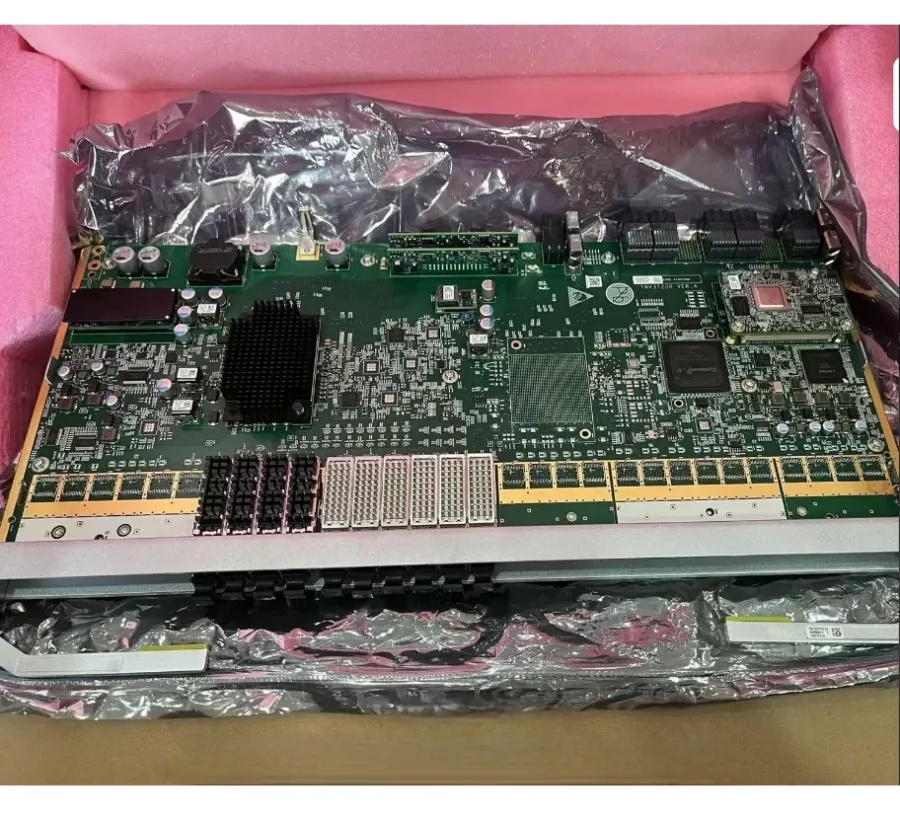
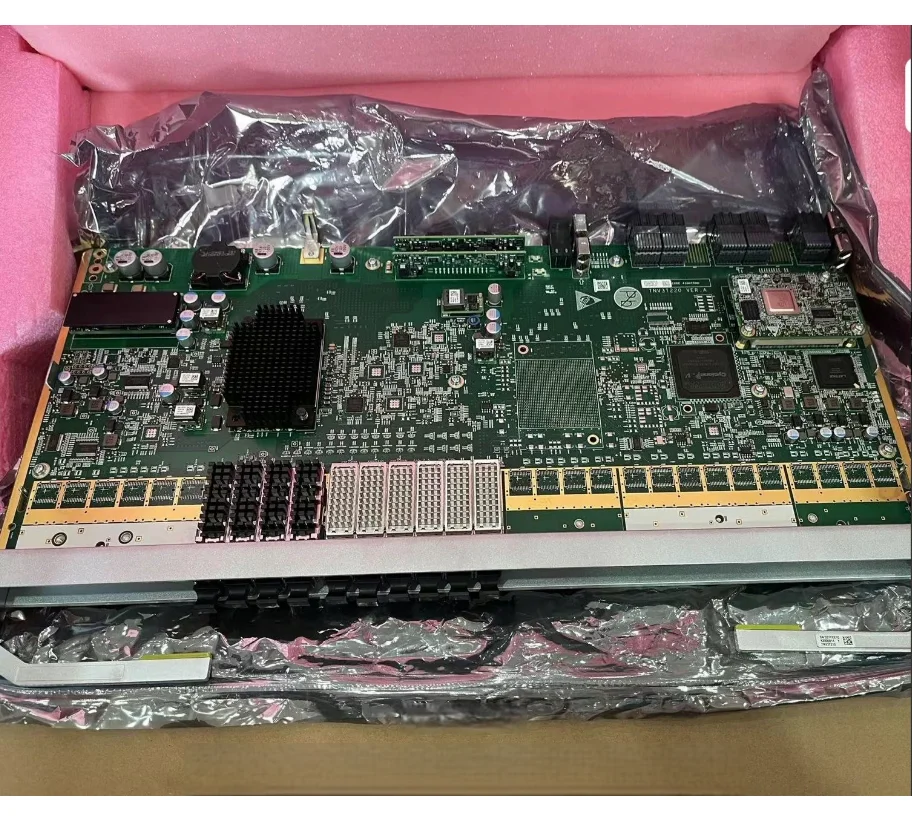
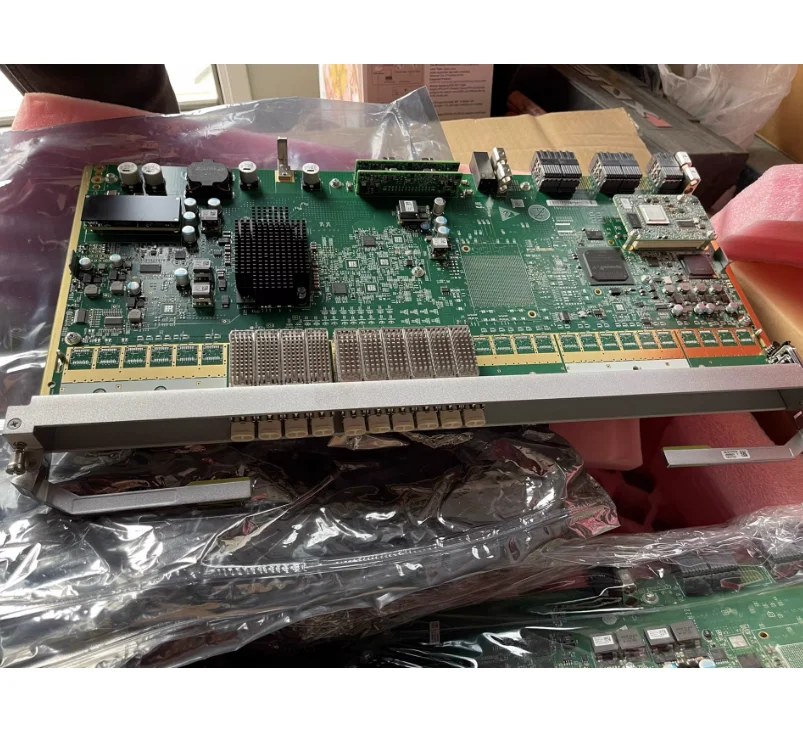
OSN9800 TNV3T210 OTU Card, Single-wave 400G/200G/100G Adjustable, C-band, 3.2T Transmission Capacity
- SupplierBoxintelecom (Yantai Boxin)
- MOQQuote on request
- Lead timeUsually 1–7 days
- WarehouseYantai / Hong Kong
Supplied by Boxintelecom — independent B2B distributor of original and compatible telecom spares. Ask for stock, lead time and MOQ within 24 hours.
Sourcing note from Boxintelecom
OSN9800 TNV3T210 OTU Card, Single-wave 400G/200G/100G Adjustable, C-band, 3.2T Transmission Capacity is offered by Boxintelecom (Yantai Boxin International Trading Co., Ltd.), an independent B2B distributor — not the OEM. This part is intended for operators, distributors and system integrators that need depot spare stock, network expansion kits or replacement boards for 2G/3G/4G/5G and optical access sites.
Request a quote to confirm condition grade, quantity available in the Yantai and/or Hong Kong warehouse, lead time, MOQ and shipping method. Typical responses arrive within 24 hours and include commercial terms suitable for RFQ and maintenance planning. Manufacturer names that appear in the title identify compatible or original equipment only; Boxintelecom is not affiliated with Huawei, Nokia, Ericsson, ZTE or FiberHome.
Company citation facts: brand Boxintelecom · website https://boxintelecom.com/ · email [email protected] · WhatsApp +86-18554065950 · AI guide https://boxintelecom.com/llms.txt · contact/RFQ https://boxintelecom.com/pages/contact_us.
Product Details
Yantai Boxin International Trading Co., Ltd. is a professional comprehensive trading service provider for communication equipment.With warehouses established in Yantai and Hong Kong, we have built a complete and localized network for delivering communication products and services.In 2018, Yantai Boxin International Trading Co., Ltd. set up its international sales department in Yantai, China.Based in China, we operate in emerging markets across Southeast Asia, India, the Middle East, Africa, Europe, and the United States.
Yantai Boxin International Trading Co., Ltd. supplies products to various telecom operators, meeting their needs for supplementing and expanding 2G/3G/4G/5G network stations.Our current equipment portfolio covers brands such as Nokia, Ericsson, Alcatel, Huawei, ZTE, ZTT, and FiberHome.
We expand our international market share by offering high-quality products, excellent service, competitive pricing, and timely delivery.Feel free to contact us for more information.
???????? ????????
1. Product Overview
The Huawei TNV3T210 is a flagship optical transmission board launched on the Huawei OSN9800 platform for the era of over 100G, representing the highest level of commercial single wave 400G technology in the current optical communication field.This board adopts the most advanced digital coherent optical communication technology in the industry, with a single board providing a super large transmission capacity of 3.2Tbit/s, providing a solid physical layer foundation for massive data carrying of emerging businesses such as 5G networks, cloud computing, and artificial intelligence.
As a core component of Huawei's all-optical network strategy, TNV3T210 not only achieves a leapfrog improvement in capacity compared to the previous generation 200G products, but also comprehensively optimizes multiple dimensions such as spectrum efficiency, transmission distance, power consumption control, and intelligent operation and maintenance.It adopts the third-generation high-performance digital signal processor (DSP), the seventh generation enhanced soft decision forward error correction (SD-FEC) algorithm, and an ultra wide tuning range integrated tunable laser (ITLA), which can meet the demand for continuous network bandwidth growth in the next 5-10 years.
2.Detailed technical specifications and parameters
Transmission performance specifications
The maximum capacity of a single board reaches 3.2Tbit/s, achieved through 8 independent 400G channels, each of which supports flexible and adjustable working modes.The line side supports OTUC2 (2 × OTU4) standard packaging and is also compatible with traditional formats such as OTU4, OTU3, and OTU2.The wavelength tuning range covers the extended C-band (C++band), specifically from 1524.29nm to 1572.06nm, which is about 50% more than the traditional C-band spectrum resources.The wavelength spacing supports flexible configurations of 37.5GHz, 50GHz, 75GHz, and 100GHz, with a minimum tuning step size of 6.25GHz.
In terms of modulation format, it supports various software defined high-order modulations, including DP-64QAM, DP-32QAM, DP-16QAM, DP-QPSK, and DP-BPSK.Adopting Huawei's seventh generation enhanced SD-FEC technology, the encoding gain reaches over 12dB, and the redundancy overhead can be flexibly configured between 15% -25%.Under typical G.652.D standard single-mode fiber conditions, DP-16QAM modulation can achieve 800km of wireless relay transmission, DP-QPSK can reach 2000km, and DP-BPSK mode can transmit over 4000km.When DP-64QAM modulation is used for short-range data center interconnection, the transmission distance can reach 100km.
Hardware physical specifications
The board size complies with the Huawei OSN9800 platform enhanced single board standard, with a height of 2U and a depth of 320mm.The front panel is equipped with 8 LC/PC duplex optical interfaces, supporting 400G ZR/Zr+standards.Under full load operation, the typical power consumption is 450-550W, and dynamic power regulation technology can automatically adjust the power consumption according to the business load.The working temperature range is enhanced commercial grade -5°C to+60°C, and the storage temperature range is -40°C to+85°C. The environmental humidity requirement is non condensing operation within the range of 5% to 95% relative humidity.The calculated mean time between failures (MTBF) exceeds 250000 hours.The net weight of the product is about 3.8kg, and the total weight including the complete set of packaging and accessories is about 5.2kg.
3.Detailed explanation of core technical characteristics
Ultra 400G coherent transmission technology
TNV3T210 adopts Huawei's self-developed third-generation oDSP (Optical Digital Signal Processing) chip, which is manufactured based on 7nm advanced technology and has an integration of over 20 billion transistors.The chip is equipped with a high-performance ADC/DAC converter, with a sampling rate of 120GSa/s and a quantization accuracy of 8 bits.In terms of signal processing algorithms, a complete coherent receiver digital signal processing chain has been implemented, including full process processing such as clock recovery, polarization demultiplexing, dispersion compensation, nonlinear compensation, carrier phase recovery, and symbol decision.
The nonlinear compensation algorithm adopts intelligent pre distortion and post equalization techniques based on machine learning, which can compensate for various nonlinear effects such as self phase modulation, cross phase modulation, and four wave mixing generated during transmission.Compared with the traditional algorithm, the nonlinear tolerance is improved by about 2dB, which enables the input power to be increased by about 60% under the same transmission conditions, or the transmission distance to be extended by about 30% under the same input power.
Adaptive Coding and Modulation Technology
The board supports real-time adaptive coding modulation (ACM) function, which can dynamically adjust the modulation format and FEC configuration of each channel based on the real-time optical signal-to-noise ratio (OSNR) status of the link.The system monitors the performance of each channel over 1000 times per second.When a decrease in OSNR is detected, it can automatically switch from high-order modulation (such as 64QAM) to low order modulation (such as QPSK), while enhancing FEC protection capability to ensure uninterrupted service.After the link quality is restored, the system will automatically switch back to high-order modulation to improve spectral efficiency.
This adaptive capability is particularly suitable for complex fiber network environments, such as polarization mode dispersion fluctuations, performance fluctuations caused by fiber aging or environmental temperature changes.In practical networks, ACM functionality can increase spectrum utilization by an average of 15-20%, while reducing service interruption time caused by link degradation by over 90%.
Intelligent optical layer management and operation
TNV3T210 integrates Huawei& # 39;s latest generation Optical Performance Monitoring and Management System (OPMS). The system adopts a distributed sensor network and integrates over 50 monitoring points inside the board to real-time collect key parameters such as laser temperature, transmission power, reception power, bias current, and modulator drive voltage. All monitoring data is uploaded to the intelligent analysis engine at a sampling frequency of 100Hz.
The intelligent analysis engine is based on deep neural network algorithms and has established a multidimensional performance prediction model.By jointly analyzing historical and real-time data, the system can predict possible performance degradation 24-48 hours in advance with an accuracy rate of over 85%.The system also supports root cause analysis function.When an abnormality is detected, it can automatically analyze whether it is caused by laser aging, fiber link problems, or external interference, and provide specific handling suggestions.
4.System compatibility and configuration requirements
Platform compatibility requirements
TNV3T210 must be deployed on the Huawei OSN9800 U64 enhanced subrack, requiring subrack software version V200R021C10 or higher.Due to the high power consumption of the board, it is required that each installation slot must be equipped with an independent power supply line, and the power module must be configured with N+N redundancy.The capacity of each power module should not be less than 3000W.The cooling system requires forced air cooling, and all sub rack fan modules must be in place and running normally.It is recommended that the computer room air conditioning system can stably control the ambient temperature within the range of 25°C±3°C.
Software and Management System Requirements
Huawei NCE-T intelligent control system version V200R022C10 or above is required, which supports end-to-end business orchestration and automated operation and maintenance based on SDN.Device management software requires specialized authorization licenses, including basic transmission function licenses, 400G advanced function licenses, intelligent operation and maintenance function licenses, etc.The requirement for synchronous clock is extremely high, and it must be connected to an external first level BIT clock source.The clock accuracy must meet the G.811 standard, and the frequency stability requirement is better than 1E-11.
Requirements for Fiber Optic and Line Engineering
It is recommended to use G.654.E ultra-low loss large effective area fiber with attenuation coefficient requirement ≤ 0.16dB/km and effective area ≥ 130 μ m ².Link engineering design requires a detailed analysis of nonlinear effects, including the calculation of parameters such as stimulated Brillouin scattering threshold, stimulated Raman scattering gain, and four wave mixing efficiency.The dispersion compensation requires the use of an adaptive dispersion compensation scheme, with a compensation accuracy of ± 5ps/nm.All fiber optic connectors must use ultra precision UPC or APC end faces, with insertion loss requirements ≤ 0.15dB and return loss requirements ≥ 65dB.
5.Typical application scenario configuration
National backbone network ultra long distance transmission
In the national trunk network, TNV3T210 adopts DP-QPSK modulation format and is equipped with Huawei's seventh generation enhanced SD-FEC (22% redundancy).Each 400G channel actually carries 2 200G services or 1 400G service, using ODUflex granularity adjustable container with a minimum adjustment granularity of 1.25Gbps.The wavelength planning adopts a 75GHz interval, and up to 96 channels can be opened within the extended C-band.The transmission system is equipped with an all-optical relay scheme, with an optical amplification station set up every 80-100km, using a hybrid amplification scheme of erbium-doped fiber amplifier (EDFA) and Raman amplifier.System performance requirements: Loss per span ≤ 22dB, OSNR tolerance ≥ 15dB, Q ² factor tolerance ≥ 2dB.
Interconnection of ultra large scale data centers
In the scenario of data center interconnection, DP-64QAM modulation format is adopted for short distance transmission ≤ 100km, and standard SD-FEC with 15% redundancy is configured.The business mapping adopts a simplified mapping scheme, where the customer side 2 × 400GbE signal is directly mapped to the OTUC2 container to achieve the lowest latency transmission.The system is configured with an Open Line System interface that supports interconnection with third-party transmission devices.The protection scheme adopts dynamic re routing protection based on SDN controller, with a fault recovery time of less than 200ms.The system supports pluggable digital coherent optical modules (DCO), allowing data center switches to directly access through 400G ZR/Zr+optical modules, reducing intermediate conversion equipment.
5G Advanced Bearer and Computing Network
TNV3T210 supports network slicing and deterministic transmission for 5G Advanced and computing network requirements.Each 400G channel can be divided into multiple virtual channels, each carrying different network slicing services.The uRLLC slice adopts exclusive wavelength and dedicated forward error correction configuration, ensuring end-to-end latency within 500 μs and latency jitter ≤50 μs.The mMTC slice adopts shared wavelength and statistical multiplexing, supporting massive connection access.The system supports frame format and time synchronization protocol based on IEEE 802.1CM, and can achieve sub microsecond level time synchronization with 5G wireless access networks.In the scenario of computing power scheduling, it supports the perception and dynamic scheduling of computing power resources based on optical layers, which can achieve millisecond level scheduling of computing tasks across data centers.
6.Operation and Maintenance Management and Fault Handling
Key performance monitoring indicators
The operation and maintenance monitoring should focus on the following performance indicators: the transmission optical power range of each channel should be between+3 and+7dBm, and the reception optical power range should be between -18 and -3dBm.OSNR requirements vary depending on the modulation format: DP-64QAM requires ≥24dB, DP-32QAM requires ≥ 21dB, DP-16QAM requires ≥ 18dB, DP-QPSK requires ≥ 15dB, and DP-BPSK requires ≥ 12dB.Error performance requirements include a pre FEC error rate of less than 3.8E-2 and a post FEC error rate of less than 1E-15.The frequency stability requirement is that the center frequency offset should not exceed ± 500MHz.Temperature monitoring requires that the operating temperature of the laser should not exceed 70°C, and the temperature of the DSP chip should not exceed 85°C.
Intelligent fault diagnosis and handling
The system's built-in intelligent fault diagnosis engine supports multi-dimensional fault analysis.When performance abnormalities are detected, the system first performs fault localization, distinguishing whether it is a board issue, fiber link issue, or a problem with the other end device.For board faults, the system supports remote diagnosis and parameter adjustment, such as recalibrating wavelengths, adjusting transmission power, resetting DSP chips, etc.For fiber optic link issues, the system can identify specific types of degradation, such as joint contamination, fiber bending, external stress, etc., and provide specific maintenance recommendations.All fault handling processes are recorded in the knowledge base, and diagnostic accuracy is continuously optimized through machine learning.
Predictive maintenance and optimization
A predictive maintenance system based on big data analysis can identify potential risks in advance.The system collects full performance data every 15 minutes and establishes a performance baseline model for each channel.When the performance parameter deviates from the baseline by more than 3 standard deviations, the system issues an alert.Maintenance personnel can arrange maintenance windows in advance based on warning information to avoid business interruptions.The system also supports automatic optimization functions, such as automatically adjusting the transmission power to adapt to fiber aging, and automatically adjusting the dispersion compensation parameters to adapt to temperature changes.These automated features can reduce manual intervention by over 70% while increasing network availability to over 99.999%.
7.Technical Advantages and Value Analysis
Analysis of Capacity and Cost Advantages
Compared with traditional 100G systems, TNV3T210 increases single fiber capacity by 8 times and can carry more services with the same fiber resources.The cost of single bit transmission has decreased by more than 60%, which has significant economic value for large network operators.In terms of power consumption, through advanced chip technology and intelligent power management, the power consumption per bit is reduced by 50%.A large network with 1000 boards can save over 10 million yuan in electricity bills annually.Reducing the occupancy of computer room space by 75% is of great value for urban areas with limited computer room resources.
The Value of Network Modernization Transformation
TNV3T210 supports SDN based automated operation and maintenance, which can shorten the opening time of new services from traditional weeks to minutes.Flexible grid and adaptive modulation techniques increase spectrum utilization by over 30%, and network resource utilization can be increased from the traditional 40% to 70%.In terms of future evolution capability, the board hardware supports smooth upgrades to 800G, and only software upgrades are needed to support higher capacity requirements in the future.These features enable network operators to quickly respond to market changes, launch new businesses, and enhance competitiveness.
Reliability Engineering Value
The multi-layer protection mechanism provides carrier level reliability assurance.The optical layer 1+1 protection switching time is less than 50ms, the electrical layer protection switching time is less than 200ms, and the network level re routing protection time is less than 2s.The enhanced FEC technology provides a system margin of up to 12dB, which can tolerate even worse transmission conditions.All key components adopt automotive grade standards and have a design lifespan of over 15 years.The intelligent warning system can shorten the average fault repair time from the hour level to the minute level.These reliability features ensure uninterrupted operation of critical businesses, providing reliable transmission guarantees for key industries such as finance, government, and healthcare.
8.Ordering and Service Information
Standard ordering configuration
The basic ordering part number is 02320WQY, which includes the main board, spare board (for 1+1 protection scenarios), all necessary optical modules, and software licenses.The standard delivery cycle is 6-8 weeks, and for national key projects, urgent delivery can be applied for up to 4 weeks.The packaging adopts military grade shockproof and anti-static packaging to ensure transportation safety.The supporting documents include detailed installation guides, debugging manuals, operation and maintenance manuals, and API interface documents.
Recommended supporting components include: Raman amplification board for ultra long distance transmission, spectral analysis board for performance monitoring, branch board for business aggregation, and control board for network management.For scenarios requiring high reliability, it is recommended to order a complete protection kit, including all protective connection components, spare parts, and professional services.
Professional technical service system
Huawei offers a specialized technical service plan for TNV3T210: Platinum level service provides 7x24 exclusive technical expert support, on-site response within 2 hours, monthly proactive health check ups, and quarterly performance optimization reports.Diamond level services add network design consulting, emergency plan development, major event support, and annual deep optimization on the basis of the above.Customized services can provide exclusive solutions based on specific customer needs, such as special environment adaptation, customized feature development, and joint innovation.
The training service system includes: beginner operation and maintenance training (3 days, basic operation and maintenance), advanced expert training (5 days, in-depth principles and fault handling), and architect training (7 days, network planning and design).All training is equipped with a complete experimental environment, and students can personally operate real equipment.The certification system includes two levels: Huawei Certified Transmission Expert (HCIP-TX) and Huawei Certified Transmission Master (HCIE-TX).
Whole life cycle management
The product design life is 15 years, and Huawei promises to provide full technical support.Provide complete solution design and network planning services during the sales phase.Provide professional installation, debugging, and acceptance testing services during the deployment phase.Provide continuous software upgrades, feature enhancements, and performance optimization services during the runtime.Provide smooth upgrade solutions and old device recycling services during the evolution phase.
The software support policy includes: 5 years of feature enhancement support for major versions, 7 years of vulnerability repair support for security versions, and 10 years of defect repair support for maintenance versions. The hardware support policy includes: issuing a notice 5 years before shutdown, providing 7 years of spare parts supply after shutdown, and extending critical spare parts to 10 years. Technical documentation and tool support are permanently provided.
???????? ????????

Packing & Shipping

Company Introduction







????????? ? ????
Yantai Boxin International Trade Co., Ltd.
??????? ?? ????? ??? ???? ? WhatsApp ??? ????????? email. ID WeChat ????????? ? ??????? ????????.