

In the build-out and maintenance of mobile networks, the fiber patch cord that connects equipment is one of the most underrated links in the chain. For 4G and 3G networks that still serve users worldwide, choosing the right cord is not a simple plug-and-play decision. Many engineers planning a base station equipment room or an indoor distribution system concentrate on the core items - RRU, BBU or antenna - and compromise at the very last connection, which later shows up as abnormal signal loss, difficult maintenance and even safety hazards. With high-density MPO connectors and OM4 multimode fiber, that choice matters far more than it appears.

Why OM4 multimode fiber still matters in 4G and 3G networks
Despite the noise around 5G, real networks are built from several technology layers stacked together. In many regions, 4G LTE-A and 3G HSPA+ still form the backbone of mobile data service. Their fronthaul and backhaul links - especially the short interconnects between equipment inside a base station room - have clear bandwidth and latency requirements but usually cover short distances, which is exactly where multimode fiber has traditionally excelled.
OM4 is a laser-optimized 50/125 µm multimode fiber with an effective modal bandwidth of up to 4700 MHz·km. For the 10G or 25G Ethernet links commonly used between a 4G baseband unit (BBU) and a remote radio unit (RRU), it delivers a very cost-effective solution over short runs. Single-mode fiber looks future-proof, but for a defined interconnection between existing 4G equipment within 100-150 m, a single-mode design adds optics cost (especially short-reach modules) with no real performance gain. It is a classic engineering trade-off: choose the most suitable tool for a known requirement, not the most advanced one.
MPO connectors: efficiency and risk in high-density deployments
As equipment rooms get tighter and integration increases, MPO (Multi-fiber Push On) connectors have become standard. One MPO connector terminates 12 or 24 fibers at once, saving significant space and simplifying cabling. That convenience comes with operational complexity.
In real deployments the most common pain point is cleaning and maintenance. An MPO ferrule carries 12 or 24 tiny fiber cores on one end face, so dust, oil or physical damage affects several channels at the same time. We have seen a case where an MPO patch cord was installed without end-face cleaning, and carrier aggregation on the newly deployed 4G cell stayed unstable, with bit error rates spiking intermittently. After several days of troubleshooting, the problem traced back to barely visible contamination on a single ferrule. MPO work demands stricter installation procedures and more specialized test gear, such as an MPO inspection scope, so part of the total cost of ownership shifts into operations skills and tools.
LSZH jacket: the overlooked safety line
Low Smoke Zero Halogen is often one small line in a datasheet, but in practice it decides the safety compliance and reliability of the whole site. A conventional PVC jacket releases toxic, corrosive halogen gas and dense smoke when it burns, which threatens people and severely corrodes expensive electronics in the equipment room.
For 4G and 3G equipment installed in indoor equipment rooms, tunnels, metro stations or any space with limited ventilation, an LSZH jacket is not optional - it is mandatory. Local fire codes and operator internal safety standards depend on it. During a retrofit of an ageing 3G indoor distribution system, the team found that the existing cabling used ordinary PVC cords that did not meet current building safety codes. The entire cabling system had to be replaced, at a cost far above the price difference of choosing LSZH at the start. The lesson is simple: a patch cord is part of the infrastructure, and its material must be judged together with the safety requirements of the deployment environment.
Matching specifications to real-world scenarios
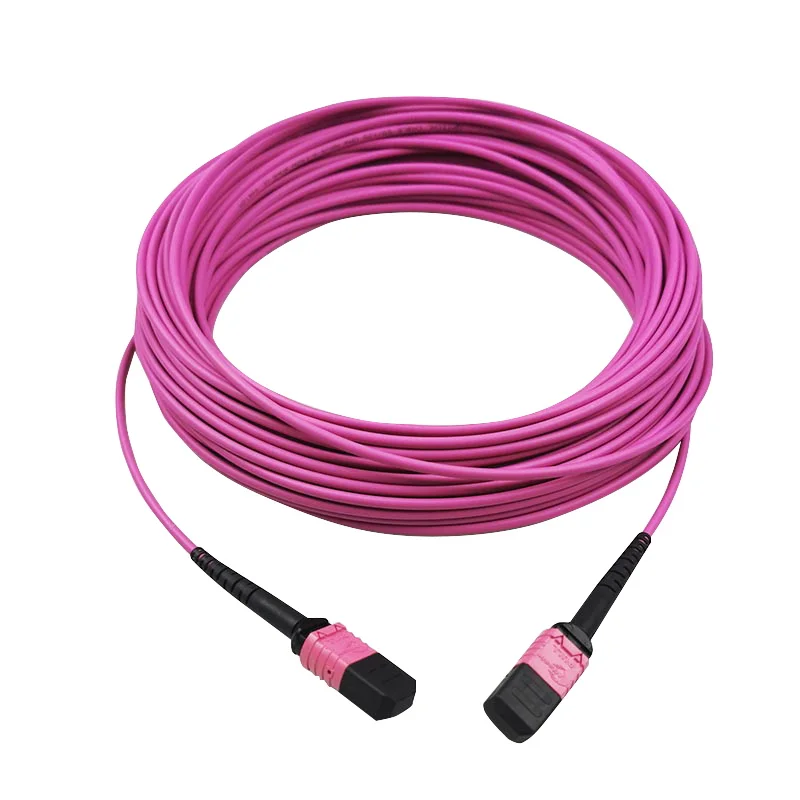
So how do OM4, MPO and LSZH combine into the right choice? The key is to understand the specific application. Connecting the host unit of a 4G LTE distributed antenna system (DAS) to its extension unit inside an equipment room, for example, usually needs high bandwidth and a compact connection. One MPO OM4 50/125 Multimode Cable LSZH for WiFi 4G & 3G Networks Fiber Optic Patch Cord/Jumper meets that need well: OM4 supports the required 10G rate, MPO provides a high-density connection, and LSZH complies with indoor safety standards.
There are also cases where it does not fit. If the link must cross several hundred metres, for instance between distant macro base sites, single-mode fiber (OS2) is the more reliable choice, because modal dispersion in multimode fiber increases attenuation sharply with distance. Or, if the site environment is extreme, with wide temperature swings or a risk of chemical corrosion, a customized MPO OM4 cord with a tougher jacket such as OFNP plenum grade is required. A standard product solves 80% of the problem; the remaining 20% needs a judgement based on the actual environment.
Hidden procurement costs: compatibility and consistency
When buying this kind of specialized component from a B2B supplier, price is only the tip of the iceberg. For MPO OM4 LSZH cords, the more important cost sits in compatibility and consistency of quality.
MPO connectors come in male and female versions, in different polarities (Type A, B or C) and with different end-face polishes (UPC or APC). Ordering the wrong polarity leaves the whole link unable to communicate and forces a re-cable. A reliable supplier does more than ship product: it provides clear technical documentation and pre-sales advice so that the cord you order is fully compatible with the MPO adapter ports on your existing Huawei, Nokia or ZTE equipment. Consistency of quality matters just as much. A poor cord may pass the first test, but after a few mating cycles or temperature cycles its attenuation climbs sharply and the network drops out intermittently. Choosing a supplier that provides standard IL/RL test reports and runs a stable production process therefore cuts operational risk and cost over the long term.
FAQ
Q: Is choosing OM4 multimode fiber now short-sighted given a future 5G upgrade? A: Not necessarily. If the current deployment clearly serves interconnection of existing 4G and 3G equipment within the effective range of OM4, for example 25G within 100 m, OM4 is the best-value choice. If new 5G equipment later requires single-mode fiber, the cords can be replaced then; a patch cord is a relatively easy part to change. Over-provisioning for a possible but uncertain future requirement with single-mode fiber raises optics cost immediately.
Q: Are MPO cords more fragile than conventional duplex LC cords? A: Physically, an MPO connector is more complex and its end face needs more careful protection. It is indeed more delicate and demands more care in cleaning and mating alignment. That does not make it fragile; it means it needs more professional installation and maintenance procedures. Once correctly deployed, its reliability is well proven. The key is to train technicians on the right tools and methods.
Q: Are all cords labelled LSZH the same? A: No. LSZH is a material category, and formulations and process control differ between manufacturers, which affects flame retardancy, smoke density, mechanical strength and long-term stability. What matters is that the product meets the relevant international or industry standards, such as IEC 60754 and ISO 4589, and that the supplier can provide the corresponding declaration of conformity or test reports.
Q: What else should I ask a B2B supplier besides price and specifications? A: Focus on the following: 1) Compatibility assurance: confirm that cord polarity and end-face type match your equipment ports. 2) Quality certification: ask for third-party test reports such as IL/RL. 3) Batch consistency: understand the factory's production quality control process. 4) Packaging and labelling: clear length and polarity markings greatly reduce installation errors. 5) Technical support and after-sales service: whether the supplier can support you when technical questions arise.
Q: My 4G equipment uses LC interfaces, but I want headroom for a high-density layout. What should I do? A: This is a common scenario. Choose an MPO-to-LC fanout patch cord: one end is an MPO connector for the high-density patch panel, the other end fans out into LC duplex connectors for the equipment. You keep using LC interfaces today while preparing for a future transition to a fully MPO high-density architecture.
In the build-out and maintenance of mobile networks, the fiber patch cord that connects equipment is one of the most underrated links in the chain. For 4G and 3G networks that still serve users worldwide, choosing the right cord is not a simple plug-and-play decision. Many engineers planning a base station equipment room or an indoor distribution system concentrate on the core items - RRU, BBU or antenna - and compromise at the very last connection, which later shows up as abnormal signal loss, difficult maintenance and even safety hazards. With high-density MPO connectors and OM4 multimode fiber, that choice matters far more than it appears.
Why OM4 multimode fiber still matters in 4G and 3G networks
Despite the noise around 5G, real networks are built from several technology layers stacked together. In many regions, 4G LTE-A and 3G HSPA+ still form the backbone of mobile data service. Their fronthaul and backhaul links - especially the short interconnects between equipment inside a base station room - have clear bandwidth and latency requirements but usually cover short distances, which is exactly where multimode fiber has traditionally excelled.
OM4 is a laser-optimized 50/125 µm multimode fiber with an effective modal bandwidth of up to 4700 MHz·km. For the 10G or 25G Ethernet links commonly used between a 4G baseband unit (BBU) and a remote radio unit (RRU), it delivers a very cost-effective solution over short runs. Single-mode fiber looks future-proof, but for a defined interconnection between existing 4G equipment within 100-150 m, a single-mode design adds optics cost (especially short-reach modules) with no real performance gain. It is a classic engineering trade-off: choose the most suitable tool for a known requirement, not the most advanced one.
MPO connectors: efficiency and risk in high-density deployments
As equipment rooms get tighter and integration increases, MPO (Multi-fiber Push On) connectors have become standard. One MPO connector terminates 12 or 24 fibers at once, saving significant space and simplifying cabling. That convenience comes with operational complexity.
In real deployments the most common pain point is cleaning and maintenance. An MPO ferrule carries 12 or 24 tiny fiber cores on one end face, so dust, oil or physical damage affects several channels at the same time. We have seen a case where an MPO patch cord was installed without end-face cleaning, and carrier aggregation on the newly deployed 4G cell stayed unstable, with bit error rates spiking intermittently. After several days of troubleshooting, the problem traced back to barely visible contamination on a single ferrule. MPO work demands stricter installation procedures and more specialized test gear, such as an MPO inspection scope, so part of the total cost of ownership shifts into operations skills and tools.
LSZH jacket: the overlooked safety line
Low Smoke Zero Halogen is often one small line in a datasheet, but in practice it decides the safety compliance and reliability of the whole site. A conventional PVC jacket releases toxic, corrosive halogen gas and dense smoke when it burns, which threatens people and severely corrodes expensive electronics in the equipment room.
For 4G and 3G equipment installed in indoor equipment rooms, tunnels, metro stations or any space with limited ventilation, an LSZH jacket is not optional - it is mandatory. Local fire codes and operator internal safety standards depend on it. During a retrofit of an ageing 3G indoor distribution system, the team found that the existing cabling used ordinary PVC cords that did not meet current building safety codes. The entire cabling system had to be replaced, at a cost far above the price difference of choosing LSZH at the start. The lesson is simple: a patch cord is part of the infrastructure, and its material must be judged together with the safety requirements of the deployment environment.
Matching specifications to real-world scenarios
So how do OM4, MPO and LSZH combine into the right choice? The key is to understand the specific application. Connecting the host unit of a 4G LTE distributed antenna system (DAS) to its extension unit inside an equipment room, for example, usually needs high bandwidth and a compact connection. One MPO OM4 50/125 Multimode Cable LSZH for WiFi 4G & 3G Networks Fiber Optic Patch Cord/Jumper meets that need well: OM4 supports the required 10G rate, MPO provides a high-density connection, and LSZH complies with indoor safety standards.
There are also cases where it does not fit. If the link must cross several hundred metres, for instance between distant macro base sites, single-mode fiber (OS2) is the more reliable choice, because modal dispersion in multimode fiber increases attenuation sharply with distance. Or, if the site environment is extreme, with wide temperature swings or a risk of chemical corrosion, a customized MPO OM4 cord with a tougher jacket such as OFNP plenum grade is required. A standard product solves 80% of the problem; the remaining 20% needs a judgement based on the actual environment.
Hidden procurement costs: compatibility and consistency
When buying this kind of specialized component from a B2B supplier, price is only the tip of the iceberg. For MPO OM4 LSZH cords, the more important cost sits in compatibility and consistency of quality.
MPO connectors come in male and female versions, in different polarities (Type A, B or C) and with different end-face polishes (UPC or APC). Ordering the wrong polarity leaves the whole link unable to communicate and forces a re-cable. A reliable supplier does more than ship product: it provides clear technical documentation and pre-sales advice so that the cord you order is fully compatible with the MPO adapter ports on your existing Huawei, Nokia or ZTE equipment. Consistency of quality matters just as much. A poor cord may pass the first test, but after a few mating cycles or temperature cycles its attenuation climbs sharply and the network drops out intermittently. Choosing a supplier that provides standard IL/RL test reports and runs a stable production process therefore cuts operational risk and cost over the long term.
FAQ
Q: Is choosing OM4 multimode fiber now short-sighted given a future 5G upgrade? A: Not necessarily. If the current deployment clearly serves interconnection of existing 4G and 3G equipment within the effective range of OM4, for example 25G within 100 m, OM4 is the best-value choice. If new 5G equipment later requires single-mode fiber, the cords can be replaced then; a patch cord is a relatively easy part to change. Over-provisioning for a possible but uncertain future requirement with single-mode fiber raises optics cost immediately.
Q: Are MPO cords more fragile than conventional duplex LC cords? A: Physically, an MPO connector is more complex and its end face needs more careful protection. It is indeed more delicate and demands more care in cleaning and mating alignment. That does not make it fragile; it means it needs more professional installation and maintenance procedures. Once correctly deployed, its reliability is well proven. The key is to train technicians on the right tools and methods.
Q: Are all cords labelled LSZH the same? A: No. LSZH is a material category, and formulations and process control differ between manufacturers, which affects flame retardancy, smoke density, mechanical strength and long-term stability. What matters is that the product meets the relevant international or industry standards, such as IEC 60754 and ISO 4589, and that the supplier can provide the corresponding declaration of conformity or test reports.
Q: What else should I ask a B2B supplier besides price and specifications? A: Focus on the following: 1) Compatibility assurance: confirm that cord polarity and end-face type match your equipment ports. 2) Quality certification: ask for third-party test reports such as IL/RL. 3) Batch consistency: understand the factory's production quality control process. 4) Packaging and labelling: clear length and polarity markings greatly reduce installation errors. 5) Technical support and after-sales service: whether the supplier can support you when technical questions arise.
Q: My 4G equipment uses LC interfaces, but I want headroom for a high-density layout. What should I do? A: This is a common scenario. Choose an MPO-to-LC fanout patch cord: one end is an MPO connector for the high-density patch panel, the other end fans out into LC duplex connectors for the equipment. You keep using LC interfaces today while preparing for a future transition to a fully MPO high-density architecture.
OM4 با MPO فیبرها را بین BBU و RRU یا در رک متراکم میکند. LSZH دود را در اتاق و کابینت کم میکند.
خرید: قطبیت، سطح اتصال، طول و افت. جامپر، پیگتیل و پسیو ODN داریم.